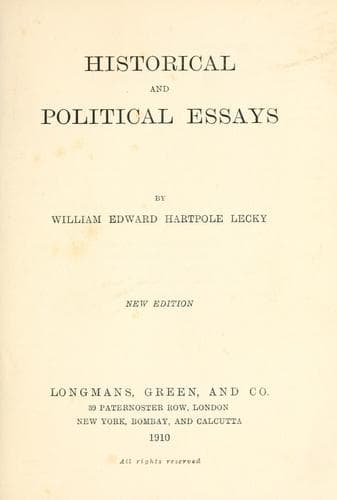
Historical and Political EssaysLecky, William Edward Hartpole
History
Historical and Political Essays
Lecky, William Edward Hartpole
History; Political science
On the whole, however, it is impossible to review the colonial history
of England without being struck with the many serious dangers that
might easily have shattered the Empire, which were averted by wise
statesmanship and timely--or at least not fatally tardy--concession.
There was the question of the criminal population which we once
transported to Australia. In the early stage of the colony, when the
population was very sparse and the need for labour very imperative,
this was not regarded as in any degree a grievance; but the time came
when it became a grievance of the gravest kind, and the Imperial power
had at length the wisdom to abandon it. There was the question of the
different and hostile religious bodies existing in different portions
of the Empire, at a time when the monopoly of political power by the
members of a single Established Church, the exclusive endowment of its
clergy, and the maintenance of the purely Protestant character of the
English Government were cherished as religious duties by politicians
at home. Yet at this very time an established and endowed Roman
Catholic Church was flourishing in Canada, and there were numerous
examples throughout the British dominions of the concurrent endowment
of different forms of religious belief by the State,[5] while in India
it abstained, with an extreme, and sometimes even an exaggerated,
scrupulousness, from all measures that could by any possibility offend
the native religious prejudices. There was the question of
Slavery--though we were freed from the most difficult part of this
problem by the secession of America. In addition, however, to its
moral aspects, it affected most vitally the material prosperity of
some of our richest colonies; it raised the very dangerous
constitutional question of the right of the Imperial Parliament to
interfere with the internal affairs of a self-governing colony, and it
brought the Home Government into more serious collision with the local
Governments than any question since the American Revolution. Whatever
may be thought of the wisdom of the measures by which we abolished
slavery in our West Indian colonies, no one at least can deny the
liberality of a Parliament which voted from Imperial resources twenty
millions for the accomplishment of the work. There was the conflict of
race and creed which between 1830 and 1840 had brought Canada to
absolute rebellion, and threatened a complete alienation of Canadian
feeling from the mother-country. This discontent was effectually
allayed and dispelled by the union of Upper and Lower Canada under a
system of constitutional government of the most liberal character,
which gave the colonists on all subjects of internal legislation a
legislative independence that was in practice almost complete.
Considered as a measure of conciliation this has proved one of the
most successful of the nineteenth century, and in spite of a few
discordant notes it may be truly said that there are few greater
Public-domain text, read in full here on John Shaqi.
Reviews
Reviews
No reviews yet
Be the first to share your thoughts on this work.
Join the Discussion
Join the discussion
Sign in to leave a comment or review.
Sign InorCreate an account