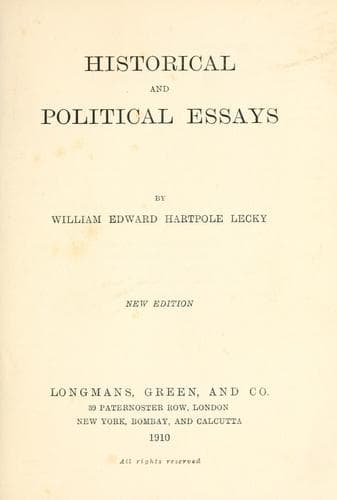
Historical and Political EssaysLecky, William Edward Hartpole
History
Historical and Political Essays
Lecky, William Edward Hartpole
History; Political science
It is the custom of our friends and neighbours on the Continent to
bestow much scornful remark on the egotism of English policy, which
attends mainly to the interests of the British Empire, and is not
ready to make war for an idea and in support of the interests of
others. I think, if it were necessary, we might fairly defend
ourselves by showing that in the past we have meddled with the affairs
of other nations quite as much as is reasonable. For my own part, I
confess that I distrust greatly these explosions of military
benevolence. They always begin by killing a great many men. They
usually end in ways that are not those of a disinterested
philanthropy. After all, an egotism that mainly confines itself to the
well-being of about a fifth part of the globe cannot be said to be of
a very narrow type, and it is essentially by her conduct to her own
Empire that the part of England in promoting the happiness of mankind
must be ultimately judged. It is indeed but too true that many of the
political causes which have played a great part on platforms, in
parties, and in Parliaments are of such a nature that their full
attainment would not bring relief to one suffering human heart, or
staunch one tear of pain, or add in any appreciable degree to the real
happiness of a single home. But most assuredly Imperial questions are
not of this order. Remember what India had been for countless ages
before the establishment of British rule. Think of its endless wars of
race and creed, its savage oppressions, its fierce anarchies, its
barbarous customs; and then consider what it is to have established
for so many years over the vast space from the Himalayas to Cape
Comorin a reign of perfect peace; to have conferred upon more than two
hundred and fifty millions of the human race perfect religious
freedom, perfect security of life, liberty, and property; to have
planted in the midst of these teeming multitudes a strong central
government, enlightened by the best knowledge of Western Europe, and
steadily occupied in preventing famine, alleviating disease,
extirpating savage customs, multiplying the agencies of civilisation
and progress. This is the true meaning of that system of government on
which Mr. Cobden looked with 'an eye of despair.' What work of human
policy--I would even say what form of human philanthropy--has ever
contributed more largely to reduce the great sum of human misery and
to add to the possibilities of human happiness?
Public-domain text, read in full here on John Shaqi.
Reviews
Reviews
No reviews yet
Be the first to share your thoughts on this work.
Join the Discussion
Join the discussion
Sign in to leave a comment or review.
Sign InorCreate an account