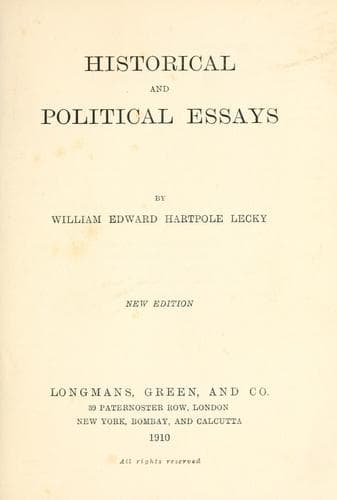
Historical and Political EssaysLecky, William Edward Hartpole
History
Historical and Political Essays
Lecky, William Edward Hartpole
History; Political science
Something has been done showing at least a disposition to meet them.
The concession of preferential duties in favour of England by some of
our most important colonies, the small subsidies made to the
maintenance of the British navy, and the far more important military
assistance given by the colonies to the mother-country in the Egyptian
and the South African wars are indicative of the feeling of closer
unity which has grown up between England and her colonies, and in
addition to the appointment of Agents-General, the introduction of a
few eminent colonial judges into the Judicial Committee of the Privy
Council, which is the Supreme Court of Appeal of the Empire, has given
the colonies some real representation in Imperial affairs. Much more,
however, in this direction may be done. There have been several
instances of eminent colonials obtaining seats in the English House of
Commons to the great advantage of the Empire, but a regular
representation of the colonies in this assembly may, I think, be
dismissed as altogether impracticable. The mere distance is a
sufficient objection, and at least nine-tenths of the business of the
House of Commons deals with purely English questions depending for
their wise solution on inherited English habits and on compromises
with existing institutions, and a large proportion of them are
problems which have been already dealt with in the colonies on other
grounds and without any of the complexities of an old country. What
reason could there be for calling in the colonists to adjudicate,
perhaps even to turn the balance, on questions relating to English
education, English licensing laws, English taxation, English
dispositions of property? The difficulty of distinguishing between
Imperial and local questions would be insuperable. The division of the
House into two categories of members with distinct spheres of voting
power would prove unworkable, and the colonial representatives would
during most of their time in Parliament have nothing to do. An
increase in the number of peers drawn from the colonies would be less
impracticable, but there would be much that is invidious in the
choice; much danger that the colonial peers living in England would
get out of touch with the colonies and become an object of envy and
jealousy; and English lawyers do not think that a large infusion of
colonial law peers would raise the competence of the Supreme Judicial
Tribunal of the Empire, which represents at present the highest legal
talent and attainments in England and deals mainly with English legal
questions. A Consultative Council, however, consisting of the
Agents-General and perhaps reinforced by additional colonial
representatives and dealing exclusively with Imperial questions, does
not seem wholly impracticable, and many competent judges believe that
a supreme legal tribunal for dealing with inter-colonial and
international conflicts might be constructed which would be both more
Public-domain text, read in full here on John Shaqi.
Reviews
Reviews
No reviews yet
Be the first to share your thoughts on this work.
Join the Discussion
Join the discussion
Sign in to leave a comment or review.
Sign InorCreate an account