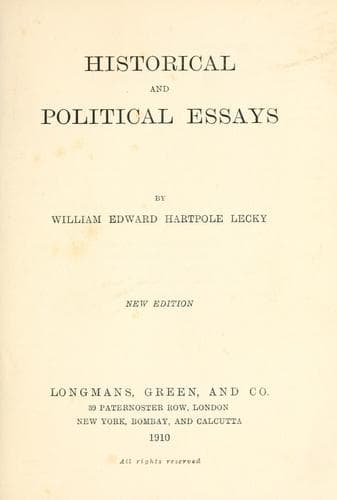
Historical and Political EssaysLecky, William Edward Hartpole
History
Historical and Political Essays
Lecky, William Edward Hartpole
History; Political science
This subject long held a
foremost place in my thoughts and studies, and I afterward wrote much
upon it in connection with the history of witchcraft and the miracles
of the Saints.
I owed much to Whately, but I was studying concurrently with him
teachers of very opposite schools, among others Coleridge, Newman, and
Emerson in English; Pascal, Bossuet, Rousseau, and Voltaire in French.
Locke's writings formed part of the college course, and I became very
familiar with them, and fully shared Hallam's special admiration for
the little treatise 'On the Conduct of the Understanding,' while
Dugald Stewart, Mackintosh, and Mill opened out wide and various
vistas in moral philosophy. The following passage from Coleridge,
which I chose as the motto of almost my first published writing,
exercised so great an influence over my later studies, and shows so
happily the direction in which I was endeavoring to turn my mind, that
I may be excused from quoting it at length:
'Let it be remembered by controversialists on all subjects, that every
speculative error which boasts a multitude of advocates has its golden
as well as its dark side; that there is always some truth connected
with it, the exclusive attention to which has misled the
understanding; some moral beauty which has given it charms for the
heart. Let it be remembered that no assailant of an error can
reasonably hope to be listened to by its advocates, who has not proved
to them that he has seen the disputed subject in the same point of
view and is capable of contemplating it with the same feelings as
themselves; for why should we abandon a cause at the persuasion of one
who is ignorant of the reasons which have attached us to it?'
Adopting an illustration which had been employed by Bossuet for
another purpose, I came to believe that religious systems resemble
those pictures occasionally seen in the museums of the curious, which
appear at first to be mere incongruous assemblages of unconnected and
unmeaning figures, till they are regarded from one particular point of
view, when these figures immediately mass themselves into a regular
form, and the whole picture assumes a coherent and symmetrical
appearance. To discover in each system this point of view; to
cultivate that peculiar form of imagination which makes it possible to
realise how different forms of opinions are held by their more
intelligent adherents, appeared to me the first condition of
understanding them.
Public-domain text, read in full here on John Shaqi.
Reviews
Reviews
No reviews yet
Be the first to share your thoughts on this work.
Elsewhere in the archive
Join the Discussion
Join the discussion
Sign in to leave a comment or review.
Sign InorCreate an account