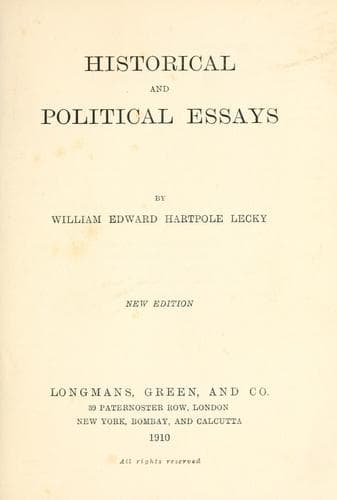
Historical and Political EssaysLecky, William Edward Hartpole
History
Historical and Political Essays
Lecky, William Edward Hartpole
History; Political science
the counters of the wise man, but the money of the fool'; he believed
that most controversies might be resolved into verbal ambiguities; and
his hatred of vagueness, grandiloquence, affected obscurity, and
rhetorical exaggeration exercised a very useful influence over young
men. He was also a most attentive and sagacious observer of human
nature, and few modern writers have written so wisely on the
diversities and the management of character and on the science of
life. In this respect he had a strong affinity to Bacon--the Bacon not
of the 'Organon,' but of the 'Essays'--and perhaps still more to
Benjamin Franklin. In theology he challenged the severest inquiry, and
believed that if honestly pursued it would lead only to orthodox
belief. 'A good man,' he once wrote, 'will indeed wish to find the
evidence of the Christian religion satisfactory; but a wise man will
not for that reason think it satisfactory, but will weigh the evidence
the more carefully on account of the importance of the question.'
His strongest antipathy was to the teaching of the Oxford 'Tracts,'
and he wrote about them with great severity, but more from the moral
than the intellectual side. He believed the Tractarian doctrines of
'reserve' and 'economy' to be essentially disingenuous; he considered
that there was good reason to conclude that leading members of the
Oxford school had remained in the Church of England for a considerable
time after they had adopted the Roman theology, had used language
deliberately intended to mask their position, and had employed their
influence as English clergymen to sap the English Church; and he
especially denounced as the grossest dishonesty the attempt that was
made in Tract XC. to show that a man was justified in subscribing to
the Articles of the Church of England and at the same time holding
everything laid down by the Council of Trent, 'though the Articles
were expressly drawn up to condemn the authoritative teaching of the
Roman Church, and after the Council of Trent had held 22 out of its
whole number of 25 sessions.' The quibbling, special-pleading,
equivocating mind which is consciously or half-consciously
endeavouring by subtle distinctions to maintain an untenable position,
was of all things the most abhorrent to him, and while the
Evangelicals denounced the Tractarians as leading men to Rome,
Whately, perhaps alone among his contemporaries, steadily predicted
that their teachings would be followed by a great period of religious
scepticism. This, he said, would be the result of the discredit they
were throwing on the evidential school, of their habit of coupling
ecclesiastical with Scripture miracles, and of their doctrine that it
is the function of faith to supply the missing links of imperfect
evidence and to impart the character of certainty to propositions
which in reason rest only on probabilities. He himself was of the
school of Grotius and Paley, and believed that simple historical
evidence established supernatural facts.
Public-domain text, read in full here on John Shaqi.
Reviews
Reviews
No reviews yet
Be the first to share your thoughts on this work.
Elsewhere in the archive
Join the Discussion
Join the discussion
Sign in to leave a comment or review.
Sign InorCreate an account