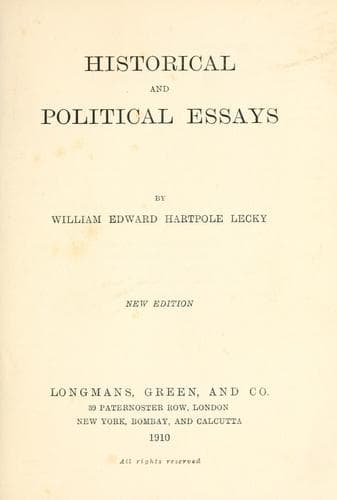
Historical and Political EssaysLecky, William Edward Hartpole
History
Historical and Political Essays
Lecky, William Edward Hartpole
History; Political science
This appears to me to have been very much the position which Carlyle
occupied towards the chief questions of his day, and it explains, I
think, in a great degree the growth of his influence. It is
remarkable, indeed, how many things there are in his writings which
appeared paradoxes when he wrote, and which now seem almost truisms.
Thus at a time when the political and intellectual ascendency of
France over the Continent was at its height, Carlyle was one of the
few men who clearly recognised the essential greatness that lay hid in
Germany, and especially in Prussia--a greatness which after the wars
of 1866 and 1870 became very evident to the world. He was one of the
first men in England to recognise the importance of German
literature, and especially the supreme greatness of Goethe. His
translation of 'Wilhelm Meister' was published in 1824, and his noble
essay on Goethe in 1832; but at first it seemed to find scarcely any
echo. The editor for whom he wrote it reported that all the opinions
he could gather about this essay were 'eminently unfavourable.' De
Quincey, who of all English critics was believed to know Germany best,
and Jeffrey, who exercised the greatest influence on English literary
opinion, combined to depreciate or ridicule Goethe. But there is now
no educated man who disputes that Carlyle in this matter was
essentially right, and that his critics were wholly wrong. And to turn
to subjects more directly connected with England, Carlyle wrote at a
time when the whole school of what was called advanced thought rested
upon the theory that the province of Government ought to be made as
small as possible, and that all the relations of classes should be
reduced to simple, temporary contracts founded on mutual interest.
According to this theory, it was the one duty of Government to keep
order. For the rest it should stand aside, and not attempt to meddle
in social or industrial questions. The most complete liberty of
thought and action should be established, and everything should be
left to unrestricted competition--to the free play of unprivileged,
untrammelled, unguided social forces. This was the theory which was
called orthodox political economy--the _laisser-faire_ system--the
philosophy of competition or supply and demand, and it was incessantly
denounced by Carlyle as Mammon worship, as 'devil take the hindmost,'
as 'pure egoism'; 'the shabbiest gospel that had been taught among
men.' He declared that in the long run no society could flourish, or
even permanently cohere, if the only relation between man and man was
a mere money tie. He maintained that what he called the condition of
England question, or, in other words, the great mass of struggling,
anarchical poverty that was growing up in the chief centres of
population, was a question which imperiously demanded the most
strenuous Government intervention--which was, in fact, far more
important than any of the purely political questions. The whole system
Public-domain text, read in full here on John Shaqi.
Reviews
Reviews
No reviews yet
Be the first to share your thoughts on this work.
Elsewhere in the archive
Join the Discussion
Join the discussion
Sign in to leave a comment or review.
Sign InorCreate an account