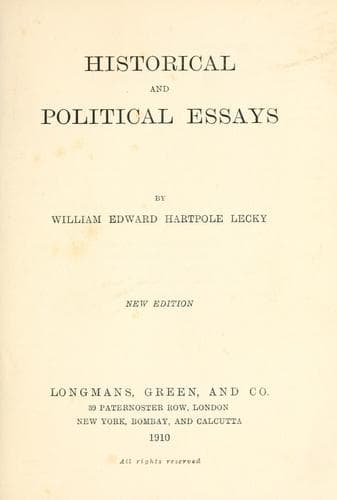
Historical and Political EssaysLecky, William Edward Hartpole
History
Historical and Political Essays
Lecky, William Edward Hartpole
History; Political science
of factory legislation, the whole system of legislation about working
men's dwellings, which has taken place in this century, has been a
realisation of the ideas of Carlyle. When Carlyle first wrote, it was
the received opinion that the education of the people was a matter in
which the Government should in no degree interfere, and that it ought
to be left altogether to individuals, or Churches, or societies. In
his work on Chartism, which was published as early as 1834, Carlyle
argued that the 'universal education of the people' was an
indispensable duty of the Government. It was not until about twenty
years ago that this duty was fully recognised in England. In the same
work he maintained that State-aided, State-organised, State-directed
emigration must one day be undertaken on a large scale, as the only
efficient agent in coping with the great masses of growing pauperism.
In his 'Past and Present,' which was published in 1843, he threw out
another idea which has proved very prolific, and which is probably
destined to become still more so. It is that it may become both
possible and needful for the master worker 'to grant his workers
permanent interest in his enterprise and theirs.'
It is evident how much less strange those ideas appear now than they
did when they were first put out some fifty years ago. One of the
most remarkable changes that has taken place during the lives of men
who are still of middle age has been in the opinion of advanced
thinkers about the function of Government. In the early days of
Carlyle the whole set, or lie, of opinion in England was towards
cutting in all directions the bands of Government control, diminishing
as much as possible the sphere of Government functions or
interference. It was a revolt against the old Tory system of paternal
Government, against the system of Guilds, against the State
regulations which once prevailed in all departments of industrial
life. In the present generation it is not too much to say that the
current has been absolutely reversed. The constantly increasing
tendency, whenever any abuse of any kind is discovered, is to call
upon Parliament to make a law to remedy it. Every year the network of
regulation is strengthened; every year there is an increasing
disposition to enlarge and multiply the functions, powers, and
responsibilities of Government. I should not be dealing sincerely with
you if I did not express my own opinion that this tendency carries
with it dangers even more serious than those of the opposite
exaggerations of a past century: dangers to character by sapping the
spirit of self-reliance and independence; dangers to liberty by
accustoming men to the constant interference of authority, and
abridging in innumerable ways the freedom of action and choice. I wish
I could persuade those who form their estimate of the province of
Government from Carlyle's 'Past and Present' and 'Latter-day
Pamphlets' to study also the admirable little treatise of Herbert
Public-domain text, read in full here on John Shaqi.
Reviews
Reviews
No reviews yet
Be the first to share your thoughts on this work.
Elsewhere in the archive
Join the Discussion
Join the discussion
Sign in to leave a comment or review.
Sign InorCreate an account