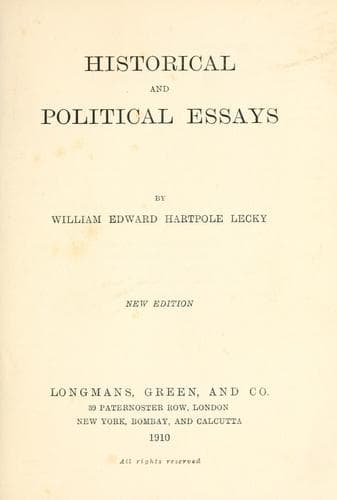
Historical and Political EssaysLecky, William Edward Hartpole
History
Historical and Political Essays
Lecky, William Edward Hartpole
History; Political science
There is another class of workers to which he himself belonged--the
men who are the teachers of mankind. He taught them by his example as
well as by his precepts. Whatever else may be said about Carlyle, no
one can question that he took his literary vocation most seriously. He
was for a long time a very poor man, but he never sought wealth by
advocating popular opinions, by pandering to common prejudices, or by
veiling most unpalatable beliefs. In the vast mass of literature which
he has bequeathed to us there is no scamped work, and every competent
judge has recognised the untiring and conscientious accuracy with
which he verified and sifted the minutest fact. His standard of
truthfulness was extremely high, and one of his great quarrels with
his age was that it was an age of half-beliefs and insincere
professions. He maintained that religious beliefs which had once been
living realities had too often degenerated into mere formulas, untruly
professed or mechanically repeated with the lips only, and without any
genuine or heartfelt conviction. He often repeated a saying of
Coleridge: 'They do not believe--they only believe that they believe.'
He used to speak of men who 'played false with their intellects'; or,
in other words, turned away their minds from unwelcome truths and by
allowing their wishes or interests to sway their judgments, persuaded
or half-persuaded themselves to believe whatever they wished. A firm
grasp of facts, he maintained, was the first characteristic of an
honest mind; the main element in all honest, intellectual work. His
own special talent was the gift of insight, the power of looking into
the heart of things, piercing to essential facts, discerning the real
characters of men, their true measure of genuine, solid worth. Creeds,
professions, opinions, circumstances, all these are the externals or
clothes of men. It is necessary to look behind them and beyond them if
we would reach the genuine human heart. One of the reasons why he
detested what he called stump oratory was because he believed it to be
a great school of insincerity. Its end was not truth, but
plausibility. It was the effort of interested men to throw opinions
into such forms as might most captivate uninstructed men; to keep back
every unpopular side; to magnify everything in them that was
seductive. He once said to me that two great curses seemed to him
eating away the heart and worth of the English people. One was drink.
The other was stump oratory, which accustomed men to say without
shame what they did not in their hearts believe to be true, and
accustomed their hearers to accept such a proceeding as perfectly
natural. And the same strong passion for veracity he carried into his
judgment of other forms of work. Rightly or wrongly, he believed that
the standard of conscientious work had been lowered in England through
the feverish competition of modern times, and under the system of what
Public-domain text, read in full here on John Shaqi.
Reviews
Reviews
No reviews yet
Be the first to share your thoughts on this work.
Elsewhere in the archive