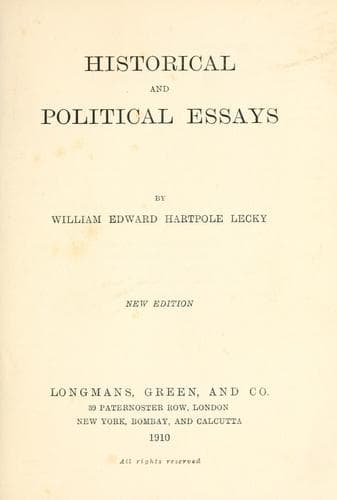
Historical and Political EssaysLecky, William Edward Hartpole
History
Historical and Political Essays
Lecky, William Edward Hartpole
History; Political science
Spencer, called 'The Man and the State,' in which the opposite side is
argued. What I have said however, is sufficient to show how
remarkably Carlyle, in some of the parts of his teaching that were
once the most unpopular, anticipated tendencies which only became very
apparent in practical politics when he was an old man or after his
death.
The main and fundamental part of his teaching is the supreme sanctity
of work; the duty imposed on every human being, be he rich or be he
poor, to find a life-purpose and to follow it out strenuously and
honestly. 'All true work,' he said, 'is religion'; and the essence of
every sound religion is, 'Know thy work and do it.' In his conception
of life all true dignity and nobility grows out of the honest
discharge of practical duty. He had always a strong sympathy with the
feudal system which annexed indissolubly the idea of public function
with the possession of property. The great landlord who is wisely
governing large districts and using all his influence to diffuse
order, comfort, education, and civilisation among his tenantry; the
captain of industry who is faithfully and honestly organising the
labour of thousands, and regarding his task as a moral duty; the rich
man who, with all the means of enjoyment at his feet, devotes his
energies 'to make some nook of God's creation a little fruitfuller,
better, more worthy of God--to make some human hearts a little wiser,
manfuller, happier, more blessed,' always received his admiration and
applause. No one, on the other hand, spoke with more contempt of a
governing class which had ceased to govern; of titles which had lost
their original meaning, and no longer implied or expressed duties
performed; of wealth that was employed solely or mainly in selfish
enjoyment or in idle show. It was Carlyle's deep conviction that the
best test of the moral worth of every nation, class, and individual,
is to be found in their standard of work and in their dislike to a
useless and idle life. As is well known, he had no sympathy with the
prevailing political ideas. He believed that men were not only not
equal, but were profoundly unequal; that it was the first interest of
society that the wisest men should be selected as its leaders, and
that the popular methods of finding the wisest were by no means those
which were most likely to succeed. 'No British man,' he complained,
'can attain to be a statesman or chief of workers till he has first
proved himself a chief of talkers.' 'The two greatest nations in the
world, the English and American, are all going to wind and tongue.' He
believed much more than his contemporaries did that there was need and
room in our modern English life for strong Government organisation,
guidance, discipline, reverence, obedience, and control. 'Wise
command, wise obedience,' he wrote in one of his 'Latter-day
Pamphlets,' 'the capability of these two is the best measure of
culture and human virtue in every man.'
Public-domain text, read in full here on John Shaqi.
Reviews
Reviews
No reviews yet
Be the first to share your thoughts on this work.
Elsewhere in the archive
Join the Discussion
Join the discussion
Sign in to leave a comment or review.
Sign InorCreate an account