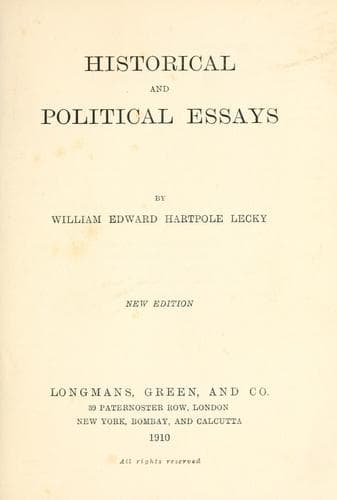
Historical and Political EssaysLecky, William Edward Hartpole
History
Historical and Political Essays
Lecky, William Edward Hartpole
History; Political science
She soon became the most attractive figure in the salon of Madame
Necker, and as the health of her mother declined she became its
central figure. Her rare accomplishments and her position as a great
heiress naturally would have drawn many suitors around her, but in
that age the determined Protestantism of her family was a formidable
barrier. It appears from something that she wrote late in life to a
German correspondent that, when a mere girl, she had come under the
spell of Louis de Narbonne, who asked her hand, and with whom, in
after years, she had relations which caused much scandal and which
greatly coloured her political life. The story that her parents at one
time contemplated a marriage between her and William Pitt, on the
occasion of his visit to France in 1783, was discredited by Lord
Stanhope; but M. d'Haussonville pronounces it to be quite true, though
there is no clear evidence that Pitt was apprised of the wish of the
Neckers. She was then only seventeen, and her vehement protest against
an English marriage nipped the project in the bud. In 1786, however, a
marriage was negotiated for her with the Swedish ambassador, the Baron
de Staël, who was at that time a special favourite of Gustavus III. It
was a marriage into which but little affection entered, and twelve
years later it ended in a separation. There was afterward, it is true,
a partial reconciliation, and she was present with her husband when he
died, in 1802, on the way from Paris to Coppet.
Her marriage gave her an independent position, and she mixed much in
the politics of the early days of the Revolution. She corresponded
regularly with the Swedish King, and formed intimate friendships with
great numbers of the guiding politicians. The proudest moment of her
life was in August 1788, when, amid a transport of transient
enthusiasm and extravagant hopefulness, her father was for the second
time called to the helm. Her devotion to him amounted almost to
adoration, and she would never acknowledge, what the rest of the world
soon perceived, that, though excellently adapted to be Minister in
quiet, regular times, he had neither the daring nor the insight, nor
the commanding power, that was needed to guide the bark of State
through the fierce storms of the Revolution. She fully shared the
enthusiasm with which the opening of the States General was received.
She mentions that on that occasion she was watching the procession
from a window with Madame de Montmorin, wife of the Minister of
Foreign Affairs, and that as she expressed her delight, her companion
said: 'You are wrong in rejoicing; great calamities will follow from
this to France and to us.' The words were truly prophetic. Madame de
Montmorin perished on the scaffold with one of her sons; the other was
drowned. Her husband was murdered in prison during the massacre of the
second of September. Her eldest daughter died in the prison hospital.
Her youngest daughter withered away when not yet thirty,
Public-domain text, read in full here on John Shaqi.
Reviews
Reviews
No reviews yet
Be the first to share your thoughts on this work.
Elsewhere in the archive
Join the Discussion
Join the discussion
Sign in to leave a comment or review.
Sign InorCreate an account