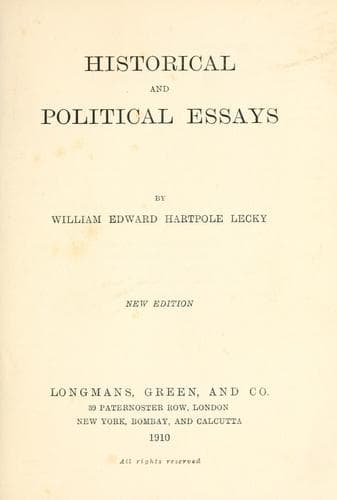
Historical and Political EssaysLecky, William Edward Hartpole
History
Historical and Political Essays
Lecky, William Edward Hartpole
History; Political science
broken-hearted by the calamities of her family.
Madame de Staël, too, soon discovered that no millennium was at hand.
She was an eye-witness of the terrible scenes of the fifth and sixth
of October, when Versailles was invaded by a half-famished mob, when
the guards were cut down and beheaded, and when the royal family were
brought captive to Paris. She clearly saw that all power was passing
from the Government to the clubs, and that the mob violence which
reigned was either instigated or deliberately connived at by the very
men whose first duty was to repress it. 'These gentlemen,' she once
said, 'are like the rainbow; they always appear when the storm is
over.' Under her influence the Swedish Embassy became the chief centre
in which the 'Constitutional Party' was organised. Narbonne and
Talleyrand were then completely devoted to her. Ségur, Choiseul, the
Prince de Broglie, and other members of the party were constantly at
her house; and at what were called her 'coalition dinners' she brought
them in contact with leading men of other groups. She had a
conspicuous talent for inspiring, encouraging, conciliating, and
organising a party; and for some months she exercised a very real
political influence. Her aim was a constitutional monarchy of the
English type; but she came gradually to believe that a republic, or at
least a change of Sovereigns, had become inevitable. She never wavered
in her devotion to liberty, order, and justice; but on minor questions
she always exhibited a spirit of compromise which was very rare in her
age and in her country. 'The true line of conduct in politics,' she
once said, 'is always to be ready to rally to the least obnoxious
party among your adversaries, even though it is far from representing
exactly your own point of view.' At the end of 1791 she had a moment
of delicious triumph, when her favourite Narbonne became Minister of
War. Marie Antoinette, who disliked her, clearly recognised her hand.
'Count Louis de Narbonne,' she wrote to Fersen, 'has been Minister of
War since yesterday. What a glory for Madame de Staël and what a
pleasure for her to have the whole army at her disposal!'
Public-domain text, read in full here on John Shaqi.
Reviews
Reviews
No reviews yet
Be the first to share your thoughts on this work.
Elsewhere in the archive
Join the Discussion
Join the discussion
Sign in to leave a comment or review.
Sign InorCreate an account