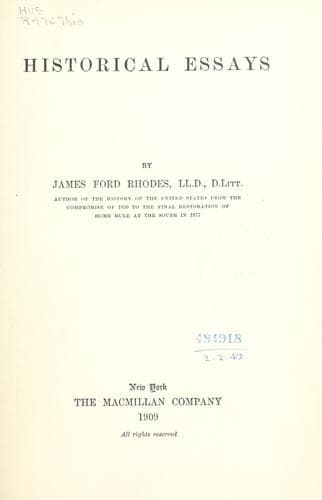
Great Britain -- History; History; United States -- History
Of Mr. Pierce as a citizen most of you, gentlemen, can speak better than
I, but it does appear to me an instance of rare civic virtue that a man
of his age, political experience, ability, and mental resources could
take pride and pleasure in his service in the House of Representatives
of his Commonwealth. He was sixty-eight years old, suffering from
disease, yet in his service last winter he did not miss one legislative
session nor a day meeting of his committee. His love for his town was a
mark of local attachment both praiseworthy and useful. "I would rather
be moderator of the Milton town-meeting," he said, "than hold any other
office in the United States."
JACOB D. COX
A paper read before the Massachusetts Historical Society at the October
meeting of 1900.
JACOB D. COX
A useful member of the legislature of his state, a general in the army
during the Civil War, governor of his state, Secretary of the Interior
in President Grant's Cabinet, a member of Congress, the president of a
large railroad, a writer of books, dean and teacher in a law school, and
a reviewer of books in the _Nation_,--such were the varied activities of
General Cox. All this work was done with credit. He bore a prominent
part in the battle of Antietam, where Ropes speaks of his "brilliant
success"; he was the second in command at the battle of Franklin, and
bore the brunt of the battle. "Brigadier-General J. D. Cox," wrote
Schofield, the commanding general, in his report, "deserves a very large
share of credit for the brilliant victory at Franklin."
The governor of the state of Ohio did not then have a great opportunity
of impressing himself upon the minds of the people of his state, but Cox
made his mark in the canvass for that office. We must call to mind that
in the year 1865, when he was the Republican candidate for governor,
President Johnson had initiated his policy of reconstruction, but had
not yet made a formal break with his party. Negro suffrage, which only a
few had favored during the last year of the war, was now advocated by
the radical Republicans, and the popular sentiment of the party was
tending in that direction. Cox had been a strong antislavery man before
the war, a supporter of President Lincoln in his emancipation measures,
but soon after his nomination for governor he wrote a letter to his
radical friends at Oberlin in opposition to negro suffrage. "You
assume," he said, "that the extension of the right of suffrage to the
blacks, leaving them intermixed with the whites, will cure all the
trouble. I believe it would rather be like the decision in that outer
darkness of which Milton speaks where
"'chaos umpire sits,
And by decision more embroils the fray.'"
Public-domain text, read in full here on John Shaqi.
Reviews
Reviews
No reviews yet
Be the first to share your thoughts on this work.
Elsewhere in the archive
Join the Discussion
Join the discussion
Sign in to leave a comment or review.
Sign InorCreate an account