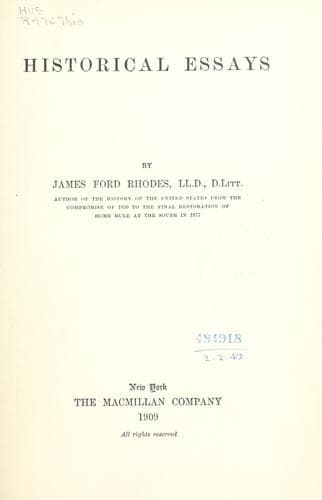
Great Britain -- History; History; United States -- History
While governor, he said in a private conversation that he had come to
the conclusion "that so large bodies of black men and white as were in
presence in the Southern States never could share political power, and
that the insistence upon it on the part of the colored people would lead
to their ruin."
President Grant appointed General Cox Secretary of the Interior, and he
remained for nearly two years in the Cabinet. James Russell Lowell, on a
visit to Washington in 1870, gave expression to the feeling among
independent Republicans. "Judge Hoar," he wrote, "and Mr. Cox struck me
as the only really strong men in the Cabinet." This was long before the
Civil Service Reform Act had passed Congress, but Secretary Cox put the
Interior Department on a merit basis, and he was ever afterwards an
advocate of civil service reform by word of mouth and with his pen.
Differences with the President, in which I feel pretty sure that the
Secretary was in the right, caused him to resign the office.
Elected to Congress in 1876, he was a useful member for one term. He has
always been known to men in public life, and when President McKinley
offered him the position of Minister to Spain something over three years
ago, it was felt that a well-known and capable man had been selected.
For various reasons he did not accept the appointment, but if he had
done so, no one could doubt that he would have shown tact and judgment
in the difficult position.
As president of the Wabash Railroad, one of the large railroads in the
West, he gained a name among business men, and five or six years ago was
offered the place of Railroad Commissioner in New York City. This was
practically the position of arbitrator between the trunk lines, but he
was then Dean of the Cincinnati Law School and interested in a work
which he did not care to relinquish.
Besides a controversial monograph, he wrote three books on military
campaigns: "Atlanta"; "The March to the Sea; Franklin and Nashville";
"The Battle of Franklin"; and he wrote four excellent chapters for
Force's "Life of General Sherman." In these he showed qualities of a
military historian of a high order. Before his death he had finished his
Reminiscences, which will be brought out by the Scribners this autumn.
His differences with President Grant while in his Cabinet left a wound,
and in private conversation he was quite severe in his strictures of
many of the President's acts, but he never let this feeling influence
him in the slightest degree in the consideration of Grant the General.
He had a very high idea of Grant's military talents, which he has in
many ways emphatically stated.
Public-domain text, read in full here on John Shaqi.
Reviews
Reviews
No reviews yet
Be the first to share your thoughts on this work.
Elsewhere in the archive
Join the Discussion
Join the discussion
Sign in to leave a comment or review.
Sign InorCreate an account