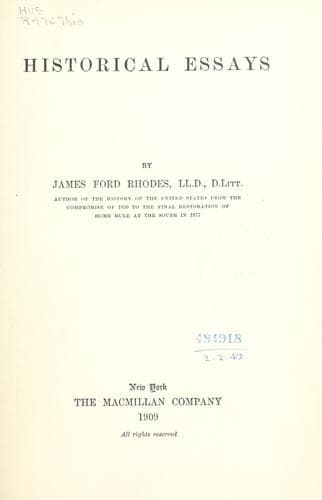
Great Britain -- History; History; United States -- History
The Whig, a very respectable party, having in its ranks the majority of
the men of wealth and education, fell a victim to the doctrine of
availability when it nominated Harrison on account of his military
reputation. He lived only one month after his inauguration, and Tyler,
the Vice President, who succeeded him, reverted to his old political
principles, which were Democratic, and broke with the Whigs. By an
adroit and steady use of the executive power he effected the annexation
of Texas, but the master spirit in this enterprise was Calhoun, his
Secretary of State. Polk, his Democratic successor, coveted California
and New Mexico, tried to purchase them, and not being able to do this,
determined on war. In fact, he had decided to send in a war message to
Congress before the news came that the Mexicans, goaded to it by the
action of General Taylor, under direct orders of the President, had
attacked an American force and killed sixteen of our dragoons. This
gave a different complexion to his message, and enabled him to get a
strong backing from Congress for his war policy. The actions of Tyler
and of Polk illustrate the power inherent in the executive office. It
might seem that the exercise of this authority, securing for us at small
material cost the magnificent domains of Texas, California, and New
Mexico, would have given these Presidents a fame somewhat like that
which Jefferson won by the purchase of Louisiana. But such has not been
the case. The main reason is that the extension of slavery was involved
in both enterprises, and the histories of these times, which have molded
historical sentiment, have been written from the antislavery point of
view. It seems hardly probable that this sentiment will be changed in
any time that we can forecast, but there is an undoubted tendency in the
younger historical students to look upon the expansion of the country as
the important consideration, and the slavery question as incidental.
Professor von Holst thought this changing historical sentiment entirely
natural, but he felt sure that in the end men would come round to the
antislavery view, of which he was so powerful an advocate.
Public-domain text, read in full here on John Shaqi.
Reviews
Reviews
No reviews yet
Be the first to share your thoughts on this work.
Elsewhere in the archive
Join the Discussion
Join the discussion
Sign in to leave a comment or review.
Sign InorCreate an account