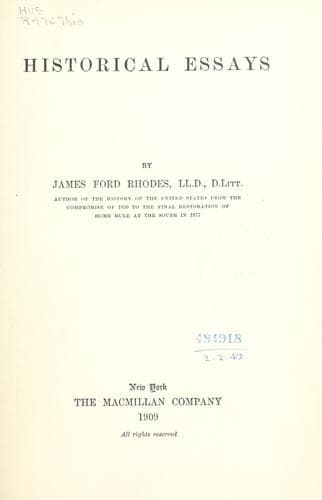
Great Britain -- History; History; United States -- History
From Taylor to Lincoln slavery dominated all other questions. Taylor was
a Southern man and a slaveholder, and by his course on the Compromise
measures attracted the favor of antislavery men; while Fillmore of New
York, who succeeded this second President to die in office, and who
exerted the power of the Administration to secure the passage of Clay's
Compromise and signed the Fugitive Slave Law, had but a small political
following at the North. Pierce and Buchanan were weak, the more positive
men in their Cabinets and in the Senate swayed them. For a part of both
of their terms the House of Representatives was controlled by the
opposition, the Senate remaining Democratic. These circumstances are
evidence both of the length of time required to change the political
complexion of the Senate and of the increasing power of the North, which
was dominant in the popular House. For the decade before the Civil War
we should study the Senate, the House of Representatives, the Supreme
Court, the action of the states, and popular sentiment. The executive is
still powerful, but he is powerful because he is the representative of a
party or faction which dictates the use that shall be made of his
constitutional powers. The presidential office loses interest:
irresolute men are in the White House, strong men everywhere else.
Lincoln is inaugurated President; the Civil War ensues, and with it an
extraordinary development of the executive power. It is an interesting
fact that the ruler of a republic which sprang from a resistance to the
English king and Parliament should exercise more arbitrary power than
any Englishman since Oliver Cromwell, and that many of his acts should
be worthy of a Tudor. Lincoln was a good lawyer who reverenced the
Constitution and the laws, and only through necessity assumed and
exercised extra-legal powers, trying at the same time to give to these
actions the color of legality. Hence his theory of the war power of the
Constitution, which may be construed to permit everything necessary to
carry on the war. Yet his dictatorship was different from Caesar's and
different from the absolute authority of Napoleon. He acted under the
restraints imposed by his own legal conscience and patriotic soul, whose
influence was revealed in his confidential letters and talks. We know
furthermore that he often took counsel of his Cabinet officers before
deciding matters of moment. Certain it is that in arbitrary arrests
Seward and Stanton were disposed to go further than Lincoln. The spirit
of arbitrary power was in the air, and unwise and unjust acts were done
by subordinates, which, although Lincoln would not have done them
himself, he deemed it better to ratify than to undo. This was notably
the case in the arrest of Vallandigham. Again, Congress did not always
do what Lincoln wished, and certain men of his own party in Congress
were strong enough to influence his actions in various ways. But, after
Public-domain text, read in full here on John Shaqi.
Reviews
Reviews
No reviews yet
Be the first to share your thoughts on this work.
Elsewhere in the archive
Join the Discussion
Join the discussion
Sign in to leave a comment or review.
Sign InorCreate an account