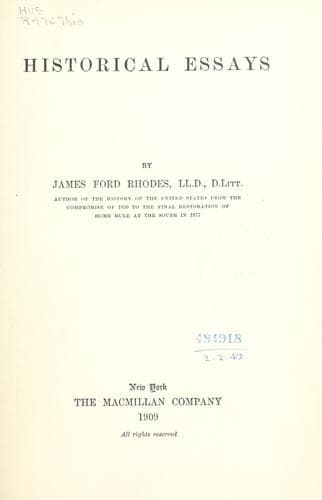
Great Britain -- History; History; United States -- History
all, he was himself a strong man exercising comprehensive authority; and
it is an example of the flexibility of the Constitution that, while it
surely did not authorize certain of Lincoln's acts, it did not expressly
forbid them. It was, for example, an open question whether the
Constitution authorized Congress or the President to suspend the writ of
_habeas corpus_.
It seems to be pretty well settled by the common sense of mankind that
when a nation is fighting for its existence it cannot be fettered by all
the legal technicalities which obtain in the time of peace. Happy the
country whose dictatorship, if dictator there must be, falls into wise
and honest hands! The honesty, magnanimity, and wisdom of Lincoln guided
him aright, and no harm has come to the great principles of liberty from
the arbitrary acts which he did or suffered to be done. On the other
hand he has so impressed himself upon the Commonwealth that he has made
a precedent for future rulers in a time of national peril, and what he
excused and defended will be assumed as a matter of course because it
will be according to the Constitution as interpreted by Abraham Lincoln.
This the Supreme Court foresaw when it rendered its judgment in the
Milligan case, saying: "Wicked men ambitious of power, with hatred of
liberty and contempt of law, may fill the place once occupied by
Washington and Lincoln, and if this right is conceded [that of a
commander in a time of war to declare martial law within the lines of
his military district and subject citizens as well as soldiers to the
rule of _his will_] and the calamities of war again befall us, the
dangers to human liberty are frightful to contemplate." No one can deny
that a danger here exists, but it is not so great as the solemn words of
the Supreme Court might lead one to believe. For Lincoln could not have
persisted in his arbitrary acts had a majority of Congress definitely
opposed them, and his real strength lay in the fact that he had the
people at his back. This may be said of the period from the first call
of troops in April, 1861, until the summer of 1862. McClellan's failure
on the Peninsula, Pope's disaster at the second battle of Bull Run, the
defeats at Fredericksburg and Chancellorsville lost Lincoln the
confidence of many; and while the emancipation proclamation of
September, 1862, intensified the support of others, it nevertheless
alienated some Republicans and gave to the opposition of the Democrats a
new vigor. But after Gettysburg and Vicksburg in July, 1863, Lincoln had
the support of the mass of the Northern people. Whatever he did the
people believed was right because he had done it. The trust each placed
in the other is one of the inspiring examples of free government and
democracy. Lincoln did not betray their confidence: they did not falter
save possibly for brief moments during the gloomy summer of 1864. The
people who gave their unreserved support to Lincoln were endued with
Public-domain text, read in full here on John Shaqi.
Reviews
Reviews
No reviews yet
Be the first to share your thoughts on this work.
Elsewhere in the archive
Join the Discussion
Join the discussion
Sign in to leave a comment or review.
Sign InorCreate an account