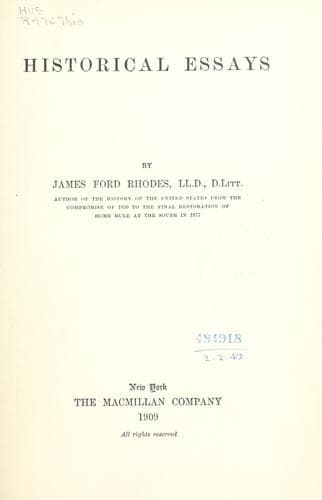
Great Britain -- History; History; United States -- History
Between the policies of a continuance of the support of the Republican
party in Louisiana or its withdrawal, a weak man would have allowed
things to drift, while a strong man of the Conkling and Chandler type
would have sustained the Packard government with the whole force at his
command. Hayes acted slowly and cautiously, asked for and received much
good counsel, and in the end determined to withdraw the United States
troops from the immediate vicinity of the State House in Louisiana. The
Packard government fell, and the Democrats took possession. The lawyers
could furnish cogent reasons why Packard was not entitled to the
governorship, although the electoral vote of Louisiana had been counted
for Hayes; but the Stalwarts maintained that no legal quibble could
varnish over so glaring an inconsistency. Indeed, it was one of those
illogical acts, so numerous in English and American history, that
resolve difficulties, when a rigid adherence to logic would tend to
foment trouble.
The inaugural address and the distinctively reform Cabinet did not suit
the party workers, and when the President declined to sustain the
Packard government in Louisiana, disapproval was succeeded by rage. In
six weeks after his inauguration Hayes was without a party; that is to
say, the men who carried on the organization were bitterly opposed to
his policy, and they made much more noise than the independent thinking
voters who believed that a man had arisen after their own hearts. Except
from the Southern wing, he received little sympathy from the Democratic
party. In their parlance, fraud was written on his brow. He had the
honor and perquisites of office which were rightfully theirs.
Public-domain text, read in full here on John Shaqi.
Reviews
Reviews
No reviews yet
Be the first to share your thoughts on this work.
Elsewhere in the archive
Join the Discussion
Join the discussion
Sign in to leave a comment or review.
Sign InorCreate an account