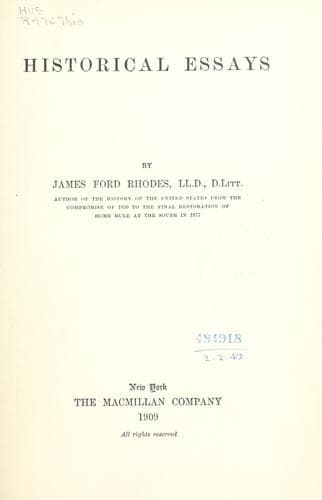
Great Britain -- History; History; United States -- History
Presidential office, essay on, 203-241;
flexibility of powers and duties, 204;
under Washington, control of treaties, 205-207;
John Adams to J. Q. Adams, extension of power, 207-209;
and annexations, 208;
and Monroe Doctrine, 209;
under Jackson, era of vulgarity, spoils system, 209-211;
Van Buren to Buchanan, annexations and slavery, 211-213;
period of weakness, 213;
under Lincoln, war power, 213-216;
under Johnson, nadir, 216;
and cabinet government, 217, 240, 263;
under Grant, 217-219, 262;
veto power, 219;
Kent on dangers in elections, 219;
contested election of 1876, 219, 254;
under Hayes, 220-222, 245-264;
under Garfield, civil service reform, 222;
under Arthur, 222;
under Cleveland, advance in power, 223-226;
under Harrison, 226-228;
under McKinley, 229-234;
and public opinion, 231-234;
character of Roosevelt, 235;
business, interruptions and their remedy, 236-239;
appointments, number of presidential offices, 236;
contact with Congress, 237;
criticisms, 238-240;
success of system, 240-241.
Pritchett, H. S., on McKinley and Philippines, 233.
Public opinion, newspapers as guide, 31, 89-92;
backing of Lincoln's extra-legal actions, 215;
influence on Presidents, 231-234.
Puritans, Macaulay and Gardiner on character, 318.
Pym, John, and Revolution of 1688, 323.
Railroad riots, 1894, Cleveland and use of Federal troops, 225;
1877, cause, 251;
strike and conflicts, 253;
use of Federal troops, 253;
social alarm, 254;
conduct of Hayes, 254.
Ranke, Leopold von, "England," 143.
Raymond, H. J., power as journalist, 90.
Reading, desultory, 64, 65, 199;
facility and retention, 69;
note-making, 76.
Reconstruction, newspapers as historical source, 94, 95;
J. D. Cox's opposition to negro suffrage, 186;
failure, final withdrawal of troops, 248, 249;
attitude of _The Nation_, 282.
Reed, T. B., and power of Speaker, 227.
Reflection in historical work, 37.
Reform act of 1832, Lord John Russell's introduction, 162.
Religion, Gibbon on, under Pagan empire, 126;
Gibbon's treatment of early Christian church, 131-133.
Republican party, newspapers as record of formation, 90;
and sound money, 227, 257.
Resumption of specie payments, opposition and success, 258, 259.
Revolution of 1688, question of Cromwell's influence, 322, 323.
Riots. _See_ Railroad.
Robertson, William, present-day reputation, 40, 111;
Gibbon on, 122.
Rome. _See_ Gibbon, Tacitus.
Roosevelt, Theodore, character, 235;
routine as President, 236, 238.
Ropes, J. C., as military historian, 13.
_Round Table_, character, 279.
Rousseau, J. J., on Gibbon as lover, 137.
Russell, Lord John, and Reform Act of 1832, 162;
Spencer Walpole's biography, 162.
Public-domain text, read in full here on John Shaqi.
Reviews
Reviews
No reviews yet
Be the first to share your thoughts on this work.
Elsewhere in the archive
Join the Discussion
Join the discussion
Sign in to leave a comment or review.
Sign InorCreate an account