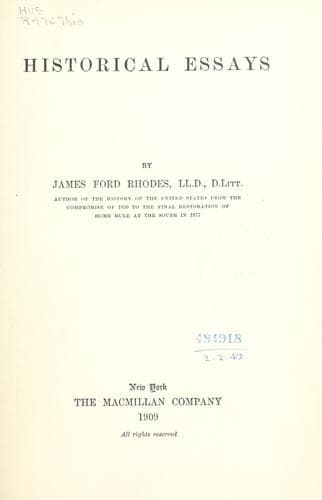
Great Britain -- History; History; United States -- History
I found the newspapers of value in the correction of logical
assumptions, which frequently appear in American historical and
biographical books, especially in those written by men who bore a part
in public affairs. By a logical assumption, I mean the statement of a
seemingly necessary consequence which apparently ought to follow some
well-attested fact or condition. A striking instance of this occurred
during the political campaign of 1856, when "bleeding Kansas" was a
thrilling catchword used by the Republicans, whose candidate for
president was Fremont. In a year and a half seven free-state men had
been killed in Kansas by the border ruffians, and these outrages,
thoroughly ventilated, made excellent campaign ammunition. But the
Democrats had a _tu quoque_ argument which ought to have done much
towards eliminating this question from the canvass.
On the night of May 24, 1856, five pro-slavery men, living on the
Pottawatomie Creek, were deliberately and foully murdered by John Brown
and seven of his disciples; and, while this massacre caused profound
excitement in Kansas and Missouri, it seems to have had no influence
east of the Mississippi River, although the fact was well attested. A
Kansas journalist of 1856, writing in 1879, made this logical
assumption: "The opposition press both North and South took up the
damning tale ... of that midnight butchery on the Pottawatomie.... Whole
columns of leaders from week to week, with startling headlines,
liberally distributed capitals, and frightful exclamation points, filled
all the newspapers." And it was his opinion that, had it not been for
this massacre, Fremont would have been elected.
But I could not discover that the massacre had any influence on the
voters in the pivotal states. I examined, or had examined, the files of
the _New York Journal of Commerce_, _New York Herald_, _Philadelphia
Pennsylvanian_, _Washington Union_, and _Cleveland Plain Dealer_, all
Democratic papers except the _New York Herald_, and I was struck with
the fact that substantially no use was made of the massacre as a
campaign argument. Yet could anything have been more logical than the
assumption that the Democrats would have been equal to their opportunity
and spread far and wide such a story? The facts in the case show
therefore that cause and effect in actual American history are not
always the same as the statesman may conceive them in his cabinet or the
historian in his study.
In the newspapers of 1850 to 1860 many speeches, and many public, and
some private, letters of conspicuous public men are printed; these are
valuable material for the history of the decade, and their use is in
entire accordance with modern historical canons.
Public-domain text, read in full here on John Shaqi.
Reviews
Reviews
No reviews yet
Be the first to share your thoughts on this work.
Join the Discussion
Join the discussion
Sign in to leave a comment or review.
Sign InorCreate an account