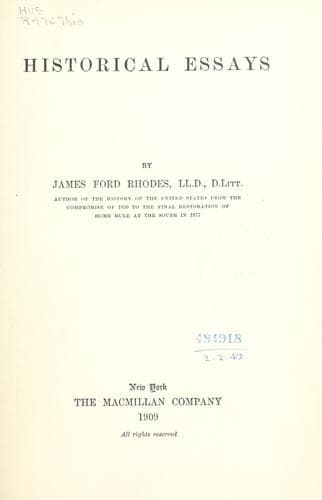
Great Britain -- History; History; United States -- History
The intellectual biography of so precocious a writer is interesting, and
fortunately it has been related by Lecky himself. When he entered
Trinity College, Dublin, in 1856, "Mill was in the zenith of his fame
and influence"; Hugh Miller was attempting to reconcile the recent
discoveries of geology with the Mosaic cosmogony. "In poetry," wrote
Lecky, "Tennyson and Longfellow reigned, I think with an approach to
equality which has not continued." In government the orthodox political
economists furnished the theory and the Manchester school the practice.
All this intellectual fermentation affected this inquiring young
student; but at first Bishop Butler's Analogy and sermons, which were
then much studied at Dublin, had the paramount influence. Of the living
men, Archbishop Whately, then at Dublin, held sway. Other writers whom
he mastered were Coleridge, Newman, and Emerson, Pascal, Bossuet,
Rousseau, and Voltaire, Dugald Stewart, and Mill. In 1857 Buckle burst
upon the world, and proved a stimulus to Lecky as well as to most
serious historical students. The result of these studies, Lecky relates,
was his History of Rationalism, published in the early part of 1865.
The claim made by many of Lecky's admirers, that he was a philosophic
historian, as distinct from literary historians like Carlyle and
Macaulay, and scientific like Stubbs and Gardiner, has injured him in
the eyes of many historical students who believe that if there be such a
thing as the philosophy of history the narrative ought to carry it
naturally. To interrupt the relation of events or the delineation of
character with parading of trite reflections or with rashly broad
generalizations is neither science nor art. Lecky has sometimes been
condemned by students who, revolting at the term "philosophy" in
connection with history, have failed to read his greatest work, the
"History of England in the Eighteenth Century." This is a decided
advance on the History of Morals, and shows honest investigation in
original material, much of it manuscript, and an excellent power of
generalization widely different from that which exhibits itself in a
paltry philosophy. These volumes are a real contribution to historical
knowledge. Parts of them which I like often to recur to are the account
of the ministry of Walpole, the treatment of "parliamentary corruption,"
of the condition of London, and of "national tastes and manners." His
Chapter IX, which relates the rise of Methodism, has a peculiarly
attractive swing and go, and his use of anecdote is effective.
Public-domain text, read in full here on John Shaqi.
Reviews
Reviews
No reviews yet
Be the first to share your thoughts on this work.
Elsewhere in the archive
Join the Discussion
Join the discussion
Sign in to leave a comment or review.
Sign InorCreate an account