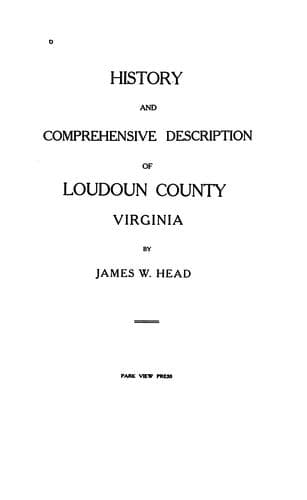
History and Comprehensive Description of Loudoun County, VirginiaHead, James William
History
History and Comprehensive Description of Loudoun County, Virginia
Head, James William
Loudoun County (Va.) -- History
When Major-General Hancock, so distinguished in the Federal Army,
heard of Baylor's exploit he laughed heartily and exclaimed: "Well,
that is the last of the Loudoun Rangers."
As indeed it proved to be!
_Mosby's Command in its Relationship to Loudoun County._
From January, 1863, until the close of the war Colonel Mosby's
partisan operations were mostly confined to the counties of Loudoun
and Fauquier, this rich, pastoral country affording subsistence for
his command and the Blue Ridge a haven to which to retreat when hard
pressed by the superior numbers that, from time to time, were sent
against him. Here he planned and executed most of the daring coups
that were to win for him international fame.[31] Here also his men
were dispersed and reassembled with marvelous facility--one of
countless manifestations of his great original genius. "They would
scatter for safety, and gather at my call like the Children of the
Mist," was what he wrote in after years. Of all his methods this has
been the least clearly understood. The explanation that he has offered
in his _War Reminiscences_ can be only partially complete; for he
could not, with propriety, point to his personal magnetism and daring
as the dominant influences, though he must have known that to an
extraordinary extent they were responsible for this almost
unparalleled devotion. "The true secret," he says, "was that it was a
fascinating life, and its attractions far more than counterbalanced
its hardships and dangers. They had no camp duty to do, which, however
necessary, is disgusting to soldiers of high spirit. To put them to
such routine work is pretty much like hitching a race horse to a
plow."
[Footnote 31: In alluding to the famous "greenback raid" (October 14,
1864), in which a party of Rangers entered a train of the Baltimore
and Ohio Railroad, near Kearneysville, capturing, among other
officers, Majors Moore and Ruggles, Federal paymasters, with their
funds, Lieutenant Grogan, of the Rangers, has said that the command,
the next day, "met at Bloomfield, in Loudoun County, and examined into
the condition of our sub-U.S. Treasury, and finding there a net
surplus of $168,000, the same was divided among our stockholders
($2,000 each) and circulated so freely in Loudoun that never
afterwards was there a pie or blooded horse sold in that section for
Confederate money."]
Public-domain text, read in full here on John Shaqi.
Reviews
Reviews
No reviews yet
Be the first to share your thoughts on this work.
Elsewhere in the archive
Join the Discussion
Join the discussion
Sign in to leave a comment or review.
Sign InorCreate an account