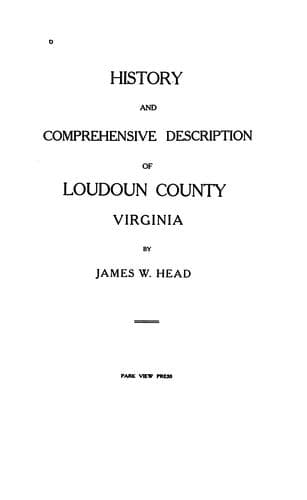
History and Comprehensive Description of Loudoun County, VirginiaHead, James William
History
History and Comprehensive Description of Loudoun County, Virginia
Head, James William
Loudoun County (Va.) -- History
This tiny mouth-piece of Virginia Unionists had naturally few
important, or even ordinary, questions of legislation to decide. The
most important was a provision for the amendment of the State
constitution with relation to its bearing on the slavery question.
"Everybody," said Governor Pierpont in his message, "loyal or
disloyal, concedes that slavery in the State is doomed. Then acting
upon this concession, call a convention of loyal delegates, to alter
the State constitution in this particular, and declare slavery and
involuntary servitude, except for crime, to be forever abolished in
the State."
A new constitution which should supercede that of 1851 and express the
Union sentiments of the Potomac legislators, was accordingly drafted.
Nominations of delegates to the constitutional convention were made in
January, 1864. By the terms of the act relative thereto, any voter in
the State who had not adhered by word or act to the Confederacy since
September 1, 1861, might be chosen a member of the convention; all
"loyal" citizens, who had not given aid or comfort to the Confederacy
since January 1, 1863, possessed the right to vote.
Elections were held January 22, 1864. Very little interest was
manifested by the people, as was evidenced by the ridiculously small
vote everywhere polled. _Loudoun's_ nominees, Dr. J.J. Henshaw, J.
Madison Downey, and E. R. Giver, were elected by a mere handful of
voters.
The convention met at Alexandria February 13, 1864, with fifteen[40]
delegates present from twelve counties. Le Roy G. Edwards, of
Portsmouth, was elected president and W.J. Cowing, secretary. A number
of radical changes in the old constitution, framed by legitimate
authority in ante-bellum days, were consummated during the two months'
session of this convention.
[Footnote 40: It should be noted that Loudoun County furnished three of
this number.]
The Alexandria government held sway very nearly two years. The
legislature met for its second session December 5, 1864, and
re-elected J. Madison Downey, of Loudoun County, speaker of the house
of delegates.
The Pierpont government was not in itself of great importance. Its
influence extended to only a dozen counties and three cities and,
"under the shadow of bayonets, it was the rule of a few aliens in the
midst of a generally hostile population. Men at the time and since
have laughed at its legitimist pretenses." It would have been
summarily dismissed by the people but for the protection afforded it
by the Federal armies. Thus it appears that the "Restored Government
of Virginia" was not based upon the consent and approval of the
governed. Yet, suited to a policy of expediency and aggression, it
was, with quivering and unseemly eagerness, recognized as the legal
government of the State by the Lincoln administration.
_Emancipation._
Public-domain text, read in full here on John Shaqi.
Reviews
Reviews
No reviews yet
Be the first to share your thoughts on this work.
Elsewhere in the archive
Join the Discussion
Join the discussion
Sign in to leave a comment or review.
Sign InorCreate an account