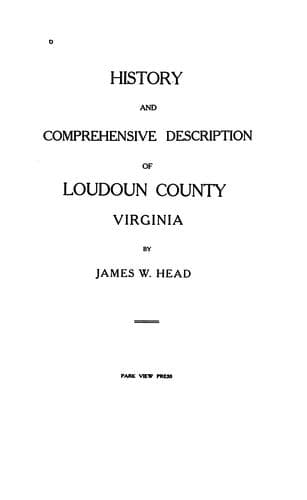
History and Comprehensive Description of Loudoun County, VirginiaHead, James William
History
History and Comprehensive Description of Loudoun County, Virginia
Head, James William
Loudoun County (Va.) -- History
A significant event of the war was the issuance by President Lincoln
of his celebrated emancipation proclamation. This highly important
measure, promulgated on New Year's day, 1863, sounded the death-knell
of slavery, an institution that, in the South, had seemed commercially
indispensable.
The tidings spread rapidly through Loudoun producing, however, no
change in the amicable relations existing between the white and
colored races. In all sections of the South some apprehension was at
first felt lest the negroes be tempted by Federal rewards to
insurrection and the state militias be required to suppress outbreaks.
The people of Loudoun, of course, shared in these early misgivings,
but here, as elsewhere, the negroes, as a whole, manifested no outward
signs of disaffection. History must record to their credit and praise
that while actual warfare was being waged on the soil of Loudoun they
quietly awaited the final issue of the fiery struggle.
Entire communities of women and children were left in their charge,
while all able-bodied white men were away on the battlefield, and the
trust was faithfully kept. Instances of criminal acts were so rare
that at this period none are recalled, and while this fidelity is
proof of the peaceable character of the negro, it is also evidence for
their owners that slavery had produced no personal hostilities between
the two races in Loudoun County, and that the treatment of the negro
by his owner under the law had been such as to maintain between them
personal attachment and mutual confidence. Many negroes accompanied
their owners to the seat of war, not to take part in battle, but to
serve in semi-military duties without exposure to danger. Some of them
marched in Maryland and Pennsylvania with the armies of Lee,
voluntarily returning, although they might have remained in the free
States without hindrance. They are still proud of the conduct of their
race in those days of anxiety and peril.
The proclamation of President Lincoln was regarded in Virginia as a
strictly political war measure, designed to place the cause of war
distinctly upon the sole question of slavery for an effect to be
produced upon foreign countries and with the purpose of making use of
negroes as soldiers in the Federal army. The issue of negro freedom
had not been distinctly made until this proclamation created it.
Hitherto it had been understood that, at the furthest, the Federal
authorities would insist only on restriction of slavery to the limits
where it already existed and a gradual emancipation upon payment of
the value of slaves held at the beginning of the war. But now it was
settled that the United States proposed to enforce by arms an
instantaneous emancipation without compensation.
_Close of the War._
Public-domain text, read in full here on John Shaqi.
Reviews
Reviews
No reviews yet
Be the first to share your thoughts on this work.
Elsewhere in the archive
Join the Discussion
Join the discussion
Sign in to leave a comment or review.
Sign InorCreate an account