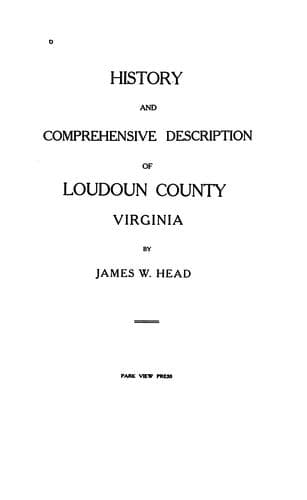
History and Comprehensive Description of Loudoun County, VirginiaHead, James William
History
History and Comprehensive Description of Loudoun County, Virginia
Head, James William
Loudoun County (Va.) -- History
Nearly every slaveholder, returning home after the fall of the
Confederacy, assembled his remaining negroes and formally notified
them of their freedom, and talked with them concerning its entailed
privileges, responsibilities, and limitations. The news had, of
course, reached them through other channels, but they had loyally
awaited the home-coming of their masters, to whom they looked for a
confirmation of the reports. Steady employment at a fixed wage was
offered most of them, and, except in the vicinity of the towns and
army posts, where they were exposed to alien influences, the negroes
usually chose to remain at their work.
Many were satisfied with the old slavery quarters while others, for
the taste of freedom that was afforded, established homes of their own
at near-by points. There were two things which the negroes of the
South felt must be done before they could be entirely free: They must
discard their masters' names and leave the old plantations if only for
a few days or weeks.
Among the most contented and industrious there was much restlessness
and neglect of work. Hunting and fishing and frolics were the order of
the day. Nearly every man acquired, in some way, a dog and gun as
badges of freedom. It was quite natural that the negroes should want a
prolonged holiday for the enjoyment of their new-found freedom; and it
is really strange that any of them worked, for there obtained an
almost universal impression--the result of the teachings of the negro
soldiers and Freedmen's Bureau officials--that the Government would
support them in idleness. But in the remote districts this impression
was vague. The advice of the old plantation preachers held many to
their work, and these did not suffer as did their brothers who flocked
to the towns.
Neither master nor freedman knew exactly how to begin anew and it was
some time before affairs emerged from the chaotic state into which the
war had plunged them. The average planter had little or no faith in
free negro labor, yet all who were now able were willing to give it a
trial. The more optimistic land-owners believed that the free negro
could in time be made an efficient laborer, in which case they were
willing to admit that the change might prove beneficial to both races.
At first, however, no one knew just how to work the free negro;
innumerable plans were devised, many tried, and few adopted.
The new regime differed but little from the old until the fall of
1865, when the Freedmen's Bureau, aided by the negro soldiers and
white emissaries, had filled the minds of the credulous ex-slaves with
false impressions of the new and glorious condition that lay before
them. Then, with the extension of the Bureau and spread of the army
posts, many of the negroes became idle, neglected the crops planted in
the spring, and moved from their old homes to the towns or wandered
aimlessly from place to place.
Public-domain text, read in full here on John Shaqi.
Reviews
Reviews
No reviews yet
Be the first to share your thoughts on this work.
Elsewhere in the archive
Join the Discussion
Join the discussion
Sign in to leave a comment or review.
Sign InorCreate an account