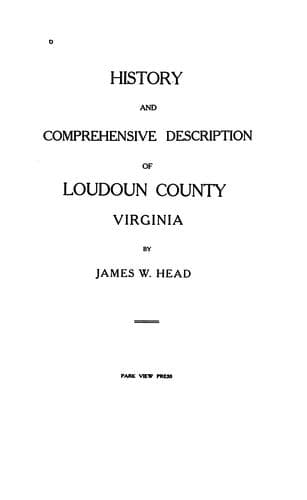
History and Comprehensive Description of Loudoun County, VirginiaHead, James William
History
History and Comprehensive Description of Loudoun County, Virginia
Head, James William
Loudoun County (Va.) -- History
Upon leaving their homes the blacks collected in gangs at the
cross-roads, in the villages and towns, and especially near the
military posts. To the negro these ordinary men in blue were beings
from another sphere who had brought him freedom, a something he could
not exactly comprehend, but which, he was assured, was a delightful
state.
Upon the negro women often fell the burden of supporting the children,
to which hardship were traceable the then common crimes of foeticide
and child murder. The small number of children during the decade of
Reconstruction was generally remarked. Negro women began to flock to
the towns; how they lived no one can tell; immorality was general
among them. The conditions of Reconstruction were unfavorable to
honesty and morality among the negroes, both male and female.
Their marriage relations were hardly satisfactory, judged by white
standards. The legislatures in 1865-1866 had declared slave marriages
binding. The reconstructionists denounced this as a great cruelty and
repealed the laws. Marriages were then made to date from the passage
of the Reconstruction Acts. As many negro men had had several wives
before that date they were relieved from the various penalties of
desertion, bigamy, adultery, etc. Some seized the opportunity to
desert their wives and children and acquire new help-meets. While much
suffering resulted from the desertion, as a rule, the negro mother
alone supported the children better than did the father who stayed.
Negro women accepted freedom with even greater seriousness than did
the men, and were not always, nor easily, induced to again take up the
familiar drudgery of field labor and domestic service. To approximate
the ease of their former mistresses, to wear fine clothes and go often
to church were their chief ambitions. Negro women had never been as
well-mannered, nor, on the whole, as good natured and cheerful as the
negro men. Both sexes, during Reconstruction, lost much of their
native cheerfulness; the men no longer went singing and shouting to
their work in the fields; some of the blacks, especially the women,
became impudent and insulting in their bearing toward the whites.
As a result of certain pernicious alien influences there soon
developed a tendency to insolent conduct on the part of the younger
negro men, who seemed convinced that civil behavior and freedom were
incompatible. With some there was a disposition not to submit to the
direction of their employers, and the negro's advisers warned him
against the "efforts of the white man to enslave" him. Consequently,
he very often refused to enter into contracts that called for any
assumption of responsibility on his part, and the few agreements to
which he became a party had first to be ratified by the Bureau. As he
had no knowledge of the obligation of contracts, he usually violated
them at pleasure.
Public-domain text, read in full here on John Shaqi.
Reviews
Reviews
No reviews yet
Be the first to share your thoughts on this work.
Elsewhere in the archive
Join the Discussion
Join the discussion
Sign in to leave a comment or review.
Sign InorCreate an account