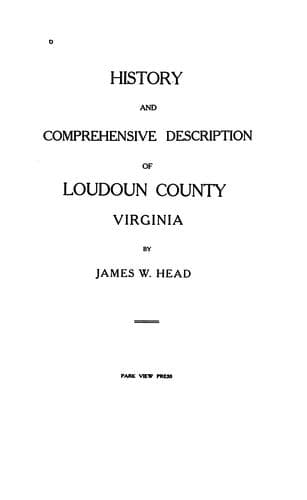
History and Comprehensive Description of Loudoun County, Virginia — John Shaqi
History and Comprehensive Description of Loudoun County, VirginiaHead, James William
History
History and Comprehensive Description of Loudoun County, Virginia
Head, James William
Loudoun County (Va.) -- History
Throughout its entire area the schist is singularly uniform in
appearance, so that only two divisions can be made with any certainty
at all. These are dependent upon a secondary characteristic, viz, the
presence of epidote in large or small quantities. The epidote occurs
in the form of lenses arranged parallel to the planes of schistosity,
reaching as high as five feet in thickness and grading from that down
to the size of minute grains. Accompanying this lenticular epidote is
a large development of quartz in lenses, which, however, do not attain
quite such a size as those of epidote. Both the quartz and epidote are
practically insoluble and lie scattered over the surface in blocks of
all sizes. In places they form an almost complete carpet and protect
the surface from removal. The resulting soil, where not too heavily
encumbered with the epidote blocks, is rich and well adapted to
farming, on account of the potash and calcium contained in the epidote
and feldspar.
Except along the narrow canyons in the Tertiary baselevel the rock is
rarely seen unless badly weathered. The light bluish green color of
the fresh rock changes on exposure to a dull gray or yellow, and the
massive ledges and slabs split up into thin schistose layers. It is
quite compact in appearance, and as a rule very few macroscopic
crystals can be seen in it.
A general separation can be made into an epidotic division
characterized by an abundance of macroscopic epidote and a
non-epidotic division with microscopic epidote. These divisions are
accented by the general finer texture of the epidotic schist.
The schists can be definitely called volcanic in many cases, from
macroscopic characters, such as the component minerals and basaltic
arrangement. In most cases, the services of the microscope are
necessary to determine their nature. Many varieties have lost all of
their original character in the secondary schistosity. None the less,
its origin as diabase can definitely be asserted of the whole mass. In
view of the fact, however, that most of the formation has a well
defined schistosity destroying its diabasic characters, and now is not
a diabase but a schist, it seems advisable to speak of it as a schist.
Sections of the finer schist in polarized light show many small areas
of quartz and plagioclase and numerous crystals of epidote, magnetite,
and chlorite, the whole having a marked parallel arrangement. Only in
the coarser varieties is the real nature of the rock apparent. In
these the ophitic arrangement of the coarse feldspars is well defined,
and in spite of their subsequent alteration the fragments retain the
crystal outlines and polarize together. Additional minerals found in
the coarse schists are calcite, ilmenite, skeleton oblivine, biotite,
and hematite.
_Rocks of the Piedmont Plain._
Public-domain text, read in full here on John Shaqi.
Reviews
Reviews
No reviews yet
Be the first to share your thoughts on this work.
Join the Discussion
Join the discussion
Sign in to leave a comment or review.
Sign InorCreate an account