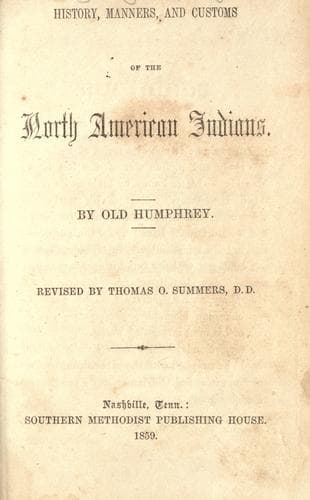
History, Manners, and Customs of the North American IndiansOld Humphrey
History
History, Manners, and Customs of the North American Indians
Old Humphrey
Indians of North America
_Hunter._ In a short time he rose again, sitting in his full dress
like the leader of a warlike tribe, and calmly and smilingly extended
his hand to the chiefs and officers, to his wives and his children.
But this, his last effort, exhausted his remaining strength. He was
lowered down on the bed, calmly drew his scalping-knife from its
sheath under his war-belt, where it had been placed, and grasped it
with firmness and dignity. With his hands crossed on his manly breast,
and with a smile on his face, he breathed his last. Thus passed away
the spirit of Oseola.
_Austin._ Poor Oseola! He died like a chief, at last.
_Hunter._ He did, but not like a Christian, and, very likely, when he
grasped his scalping-knife, before his last breath forsook him, some
glowing vision of successful combat was before him. In the pride of
his heart, perhaps, he was leading on his braves to mingle in the
clash of battle and the death-grapple with his enemies. But is this a
fit state of mind for a man to die in? Much as we may admire the
steady firmness and unsubdued courage of an Indian warrior in death,
emotions of pride and high-mindedness, and thoughts of bloodshed and
victory, are as far removed as possible from the principles of
Christianity, and most unsuitable to a dying hour. Humility,
forgiveness, repentance, hope, faith, peace and joy, are needed at
such a season; and the time will come, we trust, when Indians, taught
better by the gospel, will think and feel so.
[Illustration]
[Illustration: Mounted Chief.]
CHAPTER XIV.
The holidays of the three brothers were drawing to a close; and this
circumstance rendered them the more anxious to secure one or two more
visits to the cottage, before they settled down in right earnest to
their books. Brian and Basil talked much about the poisoned arrows,
and the mystery man; but Austin's mind was too much occupied with the
Camanchee chief on his black war-horse, and the death of the Seminole
chief Oseola, to think much of any thing else. He thought there was
something very noble in the valour of a chief leading on his tribe to
conquest; and something almost sublime in a warrior dressing himself
up in his war-robes to die. Like many other young people of ardent
dispositions, he seemed to forget, that when a victory is enjoyed, a
defeat must be endured; and that before any one can rejoice in taking
a scalp, some one must be rendered miserable or lifeless by losing it.
The remarks of the hunter, respecting the inconsistency of such
customs with the peaceful principles of religion, especially the
solemnities of a dying hour, had not been made altogether in vain; yet
still he dwelt on the image of Oseola grasping his scalping-knife,
crossing his hands over his breast, and dying with a smile on his
countenance.
Public-domain text, read in full here on John Shaqi.
Reviews
Reviews
No reviews yet
Be the first to share your thoughts on this work.
Elsewhere in the archive
Join the Discussion
Join the discussion
Sign in to leave a comment or review.
Sign InorCreate an account