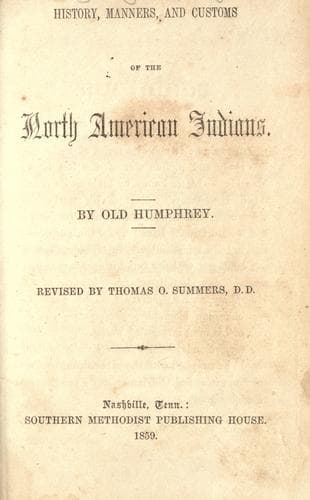
History, Manners, and Customs of the North American IndiansOld Humphrey
History
History, Manners, and Customs of the North American Indians
Old Humphrey
Indians of North America
On their next walk to the cottage, the way was beguiled by
endeavouring to call to mind all that had been told them on their last
visit; and, to do him justice, he acquitted himself uncommonly well.
It is true, that now and then his brothers refreshed his memory on
some points which had escaped him; but, on the whole, his account was
full, connected, and clear.
"And what must I tell you now?" said the hunter, as soon as he and the
young people had exchanged salutations. "Do you not know enough about
the Indians?"
To this inquiry, Brian replied that what they had heard had only
increased their curiosity to hear more.
"Well; let me consider," said the hunter. "I have told you about the
different tribes of Indians, their religion, languages, manners and
customs; their villages, wigwams, food, dress, arms and musical
instruments. I have described to you the fur trade; and dwelt on the
scenery of the country, the mountains, rivers, lakes, prairies and
many remarkable places. I have related the adventures of Black Hawk
and Nikkanochee. And, besides these things, you have had a tolerably
full account of buffaloes, bears, wild horses, wolves, deer and other
animals, with the manner of hunting them; as well as a relation of
Indian amusements, dances, sham fights, war-parties, encampments,
alarms, attacks, scalping and retreats. Let me now, then, dwell a
little on the Indian way of concluding a treaty of peace, and on a few
other matters; after which, I will conclude with the best account I
can give you of what the missionaries have done among the different
tribes."
_Austin._ I shall be very sorry when you have told us all.
_Brian._ And so shall I: for it is so pleasing to come here, and
listen to what you tell us.
_Hunter._ When it is agreed between hostile tribes that a treaty of
peace shall be made, the chiefs and medicine men of the adverse tribes
meet together, and the calumet, or peace-pipe, ornamented with eagle
quills, being produced, every one smokes a few whiffs through it. It
is then understood by them that the tomahawk is to be buried. The
pipe-of-peace dance is then performed by the warriors, to the beat of
the Indian drum and rattle, every warrior holding his pipe in his
hand.
_Brian._ That pipe-of-peace dance is a capital dance, for then
bloodshed is at an end.
_Hunter._ Unfortunately, war is apt soon to break out again, and then
the buried tomahawk becomes as busy as ever.
_Austin._ Well, I do like the Indians, in spite of all their faults,
and I think they have been used cruelly by the whites.
Public-domain text, read in full here on John Shaqi.
Reviews
Reviews
No reviews yet
Be the first to share your thoughts on this work.
Elsewhere in the archive
Join the Discussion
Join the discussion
Sign in to leave a comment or review.
Sign InorCreate an account