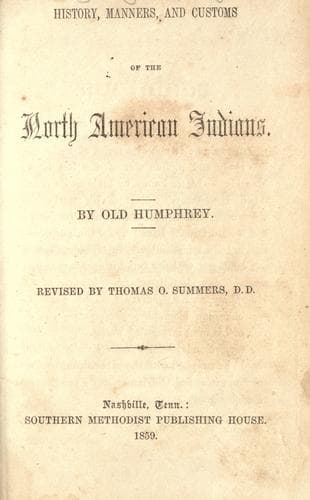
History, Manners, and Customs of the North American IndiansOld Humphrey
History
History, Manners, and Customs of the North American Indians
Old Humphrey
Indians of North America
_Hunter._ As a general remark, those Indians who have had least to do
with civilized life are the most worthy of regard. Such as live near
white men, or such as are frequently visited by them, seem to learn
quickly the vices of others, without giving up their own. To observe
the real character of red men, it is necessary to trace the turnings
and windings of the Yellow Stone River, or the yet more remote
sinuosities of the Upper Missouri. The nearer the United States, the
more servile is the Indian character; and the nearer the Rocky
Mountains, the more independent and open-hearted.
_Austin._ If I ever go among the red men, the Yellow Stone River, or
the Upper Missouri, will be the place for me.
_Hunter._ Many of the chiefs of the tribes near the Rocky Mountains
may be said to live in a state of splendour. They have the pure air of
heaven around them and rivers abounding in fish. The prairie yields
them buffaloes in plenty; and, as for their lodges and dress, some of
them may be called sumptuous. Sometimes, twenty or thirty buffalo
skins, beautifully dressed, are joined together to form a covering for
a lodge; and their robes and different articles of apparel are so
rich with ermine, the nails and claws of birds and animals, war-eagle
plumes, and embroidery of highly coloured porcupine quills, that a
monarch in his coronation robes is scarcely a spectacle more imposing.
_Austin._ Ay, I remember the dress of Mah-to-toh-pa, "the four bears,"
his buffalo robe, his porcupine-quilled leggings, his embroidered
buckskin mocassins, his otter necklace, his buffalo horns, and his
splendid head-dress of war-eagle plumes.
_Hunter._ In a state of war, it is the delight of a chief to leap on
the back of his fiery steed, decorated as the leader of his tribe, and
armed with his glittering lance and unerring bow, to lead on his band
to victory. In the chase, he is as ardent as in the battle; smiling at
danger, he plunges, on his flying steed, among a thousand buffaloes,
launching his fatal shafts with deadly effect. Thus has the Indian of
the far-west lived, and thus is he living still. But the trader and
the rum-bottle, and the rifle and the white man are on his track; and,
like his red brethren who once dwelt east of the Mississippi, he must
fall back yet farther, and gradually decline before the approach of
civilization.
_Austin._ It is a very strange thing that white men will not let red
men alone. What right have they to cheat them of their hunting-grounds?
_Hunter._ I will relate to you an account, that appeared some time ago
in most of the newspapers (though I cannot vouch for the truth of it,)
of a chief who, though he was respected by his tribe before he went
among the whites, had very little respect paid to him afterwards.
_Brian._ I hope it is a long account.
Public-domain text, read in full here on John Shaqi.
Reviews
Reviews
No reviews yet
Be the first to share your thoughts on this work.
Elsewhere in the archive
Join the Discussion
Join the discussion
Sign in to leave a comment or review.
Sign InorCreate an account