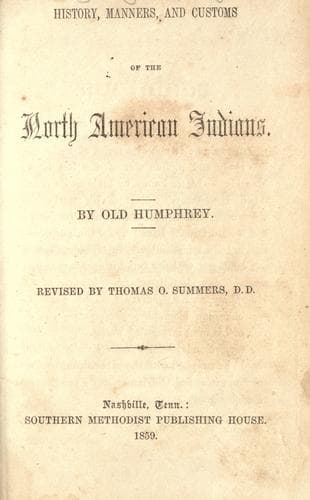
History, Manners, and Customs of the North American IndiansOld Humphrey
History
History, Manners, and Customs of the North American Indians
Old Humphrey
Indians of North America
_Hunter._ Your question calls to my mind one of the most interesting
and remarkable events of Indian history. I will endeavour to give you
a brief account of it. I refer to the invention of an alphabet by a
native Cherokee named George Guess or Guyst, who knew not how to speak
English and was never taught to read English books. It was in 1824-5
that this invention began to attract considerable attention. Having
become acquainted with the principle of the alphabet; viz. that marks
can be made the symbols of sound; this uninstructed man conceived the
notion that he could express all the syllables in the Cherokee
language by separate marks, or characters. On collecting all the
syllables which, after long study and trial, he could recall to his
memory, he found the number to be _eighty-two_. In order to express
these, he took the letters of our alphabet for a part of them, and
various modifications of our letters, with some characters of his own
invention, for the rest. With these symbols he set about writing
letters; and very soon a correspondence was actually maintained
between the Cherokees in Wills Valley, and their countrymen beyond the
Mississippi, 500 miles apart. This was done by individuals who could
not speak English, and who had never learned any alphabet, except this
syllabic one, which Guess had invented, taught to others, and
introduced into practice. The interest in this matter increased till,
at length, young Cherokees travelled a great distance to be instructed
in this easy method of writing and reading. In three days they were
able to commence letter-writing, and return home to their native
villages prepared to teach others. Either Guess himself, or some other
person afterwards, discovered _four_ other syllables; making all the
known syllables of the Cherokee language _eighty-six_. This is a very
curious fact; especially when it is considered that the language is
very copious on some subjects, a single verb undergoing some thousands
of inflections. All syllables in the Cherokee language end with
vowels. The same is true of the language of the islanders of the
Pacific ocean. But in the Choctaw language, syllables often end with
consonants.
"Some months since," says a report of the Cherokee mission in 1825,
"Mr. David Brown commenced the translation of the New Testament into
Cherokee, with the occasional assistance of two or three of his
countrymen, who are more thoroughly acquainted, than he is, with that
language. Already the four Gospels are translated, and fairly copied;
and if types and a press were ready, they could be immediately revised
and printed and read. Extracts are now transcribed and perused by a
few.
"It is manifest that such a translation must be very imperfect; but it
is equally manifest that much divine truth maybe communicated by it,
and probably with more accuracy than is commonly done by preaching,
either with an interpreter, or without one."
Another account is a little more full:
Public-domain text, read in full here on John Shaqi.
Reviews
Reviews
No reviews yet
Be the first to share your thoughts on this work.
Elsewhere in the archive
Join the Discussion
Join the discussion
Sign in to leave a comment or review.
Sign InorCreate an account