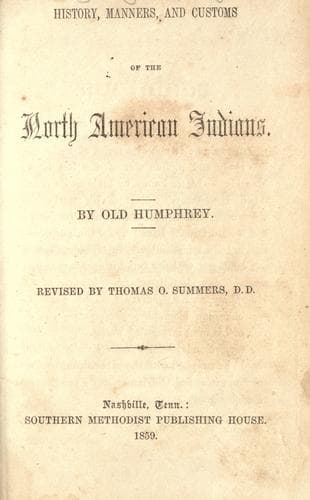
History, Manners, and Customs of the North American IndiansOld Humphrey
History
History, Manners, and Customs of the North American Indians
Old Humphrey
Indians of North America
"It is well worthy of notice, that Mr. Guyst, the inventor, is a man
past the middle age. He had seen books, and, I have been told, had an
English spelling-book in his house; but he could not read a word in
any language, nor speak the English language at all. His alphabet
consists of eighty-six characters, each of which represents a
syllable, with the exception of one, which has the sound of the
English _s_, and is prefixed to other characters when required. These
eighty-six characters are sufficient to write the language, at least
intelligibly. The alphabet is thought by some of the Cherokees to need
improvement; but, as it is, it is read by a very large portion of the
people, though I suppose there has been no such thing as a school in
which it has been taught, and it is not more than two or three years
since it was invented. A few hours of instruction are sufficient for a
Cherokee to learn to read his own language intelligibly. He will not,
indeed, so soon be able to read _fluently_: but when he has learned to
read and understand, fluency will be acquired by practice. The extent
of my information will not enable me to form a probable estimate of
the number in the nation who can thus read, but I am assured, by those
who had the best opportunity of knowing, that there is no part of the
nation where the new alphabet is not understood. That it will prevail
over every other method of writing the language, there is no doubt."
_Austin._ Did they find the language could be easily written and
printed?
_Hunter._ In 1828 one of the missionaries of the American Board
devoted himself to the acquisition of the language, with a view to
translating the Scriptures, and preparing school-books and tracts for
the general instruction of the people. As he proceeded in the study of
the language, he found it more and more wonderful in its structure,
and the difficulties which must have attended the labour of reducing
it to a system became more and more apparent.
Before this, however, the enthusiasm of the people was kindled: great
numbers had learned to read; they were circulating hymns and portions
of Scripture, and writing letters every day, and even procured a medal
to present to the inventor, as a token of their gratitude for this
wonderful method of writing their own language. They began to talk
much of printing in the new and famous characters; appropriated money
to procure a press and types, and anticipated with joy the printing of
the Scriptures in a language they could read and understand.
At the same time the missionaries to the Choctaws were reducing their
language to a system. One of them collected more than 3000 words,
arranged according to the subjects to which they refer, which he
translated into English. Ten hymns were also translated into Choctaw,
and a spelling-book prepared in the same language.
_Austin._ But let us hear what became of the Guyst's Cherokee
alphabet. As that was an invention of his own, it seems very
wonderful.
Public-domain text, read in full here on John Shaqi.
Reviews
Reviews
No reviews yet
Be the first to share your thoughts on this work.
Elsewhere in the archive
Join the Discussion
Join the discussion
Sign in to leave a comment or review.
Sign InorCreate an account