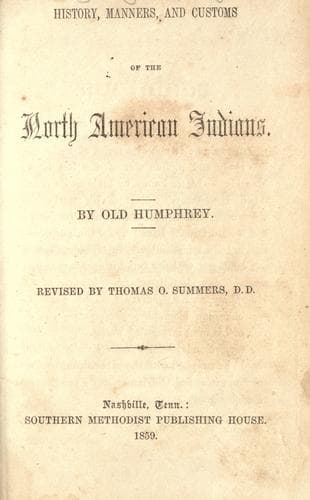
History, Manners, and Customs of the North American IndiansOld Humphrey
History
History, Manners, and Customs of the North American Indians
Old Humphrey
Indians of North America
_Hunter._ I have not a word of complaint to make. The Indians have
been represented as treacherous, dishonest, reserved, and sour in
their disposition; but, instead of this, I have found them generally,
though not in all cases, frank, upright, hospitable, light-hearted,
and friendly. Those who have seen Indians smarting under wrongs, and
deprived, by deceit and force, of their lands, hunting-grounds, and
the graves of their fathers, may have found them otherwise: and no
wonder; the worm that is trodden on will writhe; and man, unrestrained
by Divine grace, when treated with injustice and cruelty, will turn on
his oppressor.
_Austin._ Say what you will, I like the Indians.
_Hunter._ That there is much of evil among Indians is certain; much of
ignorance, unrestrained passions, cruelty, and revenge: but they have
been misrepresented in many things. I had better tell you the names of
some of the chiefs of the tribes, or of some of the most remarkable
men among them.
_Austin._ Yes; you cannot do better. Tell us the names of all the
chiefs, and the warriors, and the conjurors, and all about them.
_Hunter._ The Blackfeet Indians are a very warlike people;
_Stu-mick-o-sucks_ was the name of their chief.
_Austin._ Stu-mick-o-sucks! What a name! Is there any meaning in it?
_Hunter._ O yes. It means, "the back fat of the buffalo;" and if you
had seen him and _Peh-to-pe-kiss_, "the ribs of the eagle," another
chief dressed up in their splendid mantles, buffaloes' horns, ermine
tails, and scalp-locks, you would not soon have turned your eyes from
them.
_Brian._ Who would ever be called by such a name as that? The back fat
of the buffalo!
_Hunter._ The Camanchees are famous on horseback. There is no tribe
among the Indians that can come up to them, to my mind, in the
management of a horse, and the use of the lance: they are capital
hunters. The name of their chief is _Ee-shah-ko-nee_, or "the bow and
quiver." I hardly ever saw a larger man among the Indians than
_Ta-wah-que-nah_, the second chief in power. Ta-wah-que-nah means "the
mountain of rocks," a very fit name for a huge Indian living near the
Rocky Mountains. When I saw _Kots-o-ko-ro-ko_, or "the hair of the
bull's neck," (who is, if I remember right, the third chief,) he had a
gun in his right hand, and his warlike shield on his left arm.
_Austin._ If I go among the Indians, I shall stay a long time with the
Camanchees; and then I shall, perhaps, become one of the most skilful
horsemen, and one of the best hunters in the world.
_Brian._ And suppose you get thrown off your horse, or killed in
hunting buffaloes, what shall you say to it then?
_Austin._ Oh, very little, if I get killed; but no fear of that. I
shall mind what I am about. Tell us who is the head of the Sioux?
_Hunter._ When I was at the upper waters of the Mississippi and
Missouri rivers, _Ha-won-je-tah_, or "the one horn," was chief; but
since then, being out among the buffaloes, a buffalo bull attacked and
killed him.
Public-domain text, read in full here on John Shaqi.
Reviews
Reviews
No reviews yet
Be the first to share your thoughts on this work.
Join the Discussion
Join the discussion
Sign in to leave a comment or review.
Sign InorCreate an account