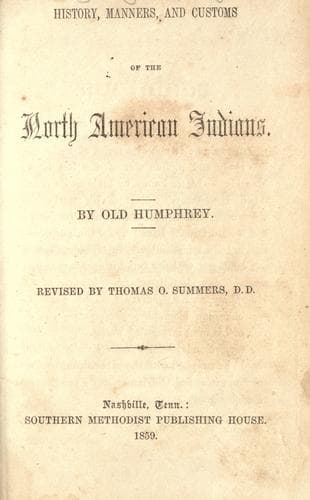
History, Manners, and Customs of the North American IndiansOld Humphrey
History
History, Manners, and Customs of the North American Indians
Old Humphrey
Indians of North America
_Hunter._ When America was first discovered, the inhabitants, though
for the most part partaking of one general character, were not without
variety. The greater part, as I told you, were, both in hot and cold
latitudes, red men with black hair, and without beards. They, perhaps,
might have been divided into four parts: the Mexicans and Peruvians,
who were, to a considerable extent, civilized; the Caribs, who
inhabited the fertile soil and luxuriant clime of the West Indies; the
Esquimaux, who were then just the same people as they are now, living
in the same manner by fishing; and the Red Men, or North American
Indians.
_Austin._ Then the Esquimaux are not Red Indians.
_Hunter._ No; they are more like the people who live in Lapland, and
in the North of Asia; and for this reason, and because the distance
across Behring's Straits is so short, it is thought they came from
Asia, and are a part of the same people. The red men are, however,
different; and as we agreed that I should tell you about the present
race of them, perhaps I may as well proceed.
_Austin._ Yes. Please to tell us first of their wigwams, and their
villages, and how they live.
_Brian._ And what they eat, and what clothes they wear.
_Basil._ And how they talk to one another.
_Austin._ Yes; and all about their spears and tomahawks.
_Hunter._ The wigwams of the Indians are of different kinds: some are
extremely simple, being formed of high sticks or poles, covered with
turf or the bark of trees; while others are very handsome. The Sioux,
the Blackfeet, and the Crows, form their wigwams nearly in the same
manner; that is, by sewing together the skins of buffaloes, after
properly dressing them, and making them into the form of a tent. This
covering is then supported by poles. The tent has a hole at the top,
to let out the smoke, and to let in the light.
_Austin._ Ay, that is a better way of making a wigwam than covering
over sticks with turf.
_Hunter._ The wigwams, or lodges, of the Mandans are round. A circular
foundation is dug about two feet deep; timbers six feet high are set
up all around it, and on these are placed other long timbers, slanting
inwards, and fastened together in the middle, like a tent, leaving
space for light and for the smoke to pass. This tent-like roof is
supported by beams and upright posts, and it is covered over outwardly
by willow boughs and a thick coating of earth; then comes the last
covering of hard tough clay. The sun bakes this, and long use makes it
solid. The outside of a Mandan lodge is almost as useful as the
inside; for there the people sit, stand, walk, and take the air. These
lodges are forty, fifty, or sixty feet wide.
_Brian._ The Mandan wigwam is the best of all.
Public-domain text, read in full here on John Shaqi.
Reviews
Reviews
No reviews yet
Be the first to share your thoughts on this work.
Join the Discussion
Join the discussion
Sign in to leave a comment or review.
Sign InorCreate an account