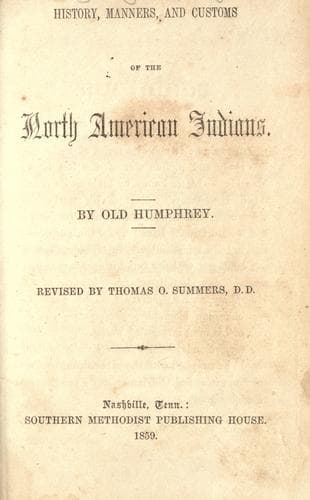
History, Manners, and Customs of the North American IndiansOld Humphrey
History
History, Manners, and Customs of the North American Indians
Old Humphrey
Indians of North America
_Hunter._ Not always. Scalps are war trophies, and are generally
regarded as proofs of the death of an enemy; but an Indian, inflamed
with hatred and rage, and excited by victory, will not always wait
till his foe has expired before he scalps him. The hair, as well as
the scalp, of a fallen foe is carried off by the victorious Indian,
and with it his clothes are afterwards ornamented. It is said, that,
during the old French war, an Indian slew a Frenchman who wore a wig.
The warrior stooped down, and seized the hair for the purpose of
securing the scalp. To his great astonishment, the wig came off,
leaving the head bare. The Indian held it up, and examining it with
great wonder, exclaimed, in broken English, "Dat one big lie."
_Brian._ How the Indian would stare!
_Basil._ He had never seen a wig before, I dare say.
_Hunter._ The arms of Indians, offensive and defensive, are, for the
most part, those which I have mentioned--the club, the tomahawk, the
bow and arrow, the spear, the shield and the scalping-knife. But the
use of fire-arms is gradually extending among them. Some of their
clubs are merely massy pieces of hard, heavy wood, nicely fitted to
the hand, with, perhaps, a piece of hard bone stuck in the head part;
others are curiously carved into fanciful and uncouth shapes; while,
occasionally, may be seen a frightful war-club, knobbed all over with
brass nails, with a steel blade at the end of it, a span long.
_Austin._ What a terrible weapon, when wielded by a savage!
[Illustration: _a_, scalping-knife. _b_, ditto, in sheath.
_c_, _d_, war-clubs. _e_, _e_, tomahawks. _g_, whip.]
_Brian._ I would not go among the Indians, with their clubs and
tomahawks, for a thousand dollars.
_Basil._ Nor would I: they would be sure to kill me.
_Hunter._ The tomahawk is often carved in a strange manner; and some
of the bows and arrows are admirable. The bow formed of bone and
strong sinews is a deadly weapon; and some Indians have boasted of
having sent an arrow from its strings right through the body of a
buffalo.
_Austin._ What a strong arm that Indian must have had! Through a
buffalo's body!
_Hunter._ The quiver is made of the skin of the panther, or the otter;
and some of the arrows it contains are usually poisoned.
_Brian._ Why, then, an arrow is sure to kill a person, if it hits him.
_Hunter._ It is not likely that an enemy, badly wounded with a
poisoned arrow, will survive; for the head is set on loosely, in order
that, when the arrow is withdrawn, the poisoned barb may remain in the
wound. How opposed are these cruel stratagems of war to the precepts
of the gospel of peace, which are "Love your enemies, bless them that
curse you, do good to them that hate you, and pray for them which
despitefully use you, and persecute you!"
_Basil._ What will you do, Austin, if you go among the Indians, and
they shoot you with a poisoned arrow?
_Austin._ Oh, I shall carry a shield. You heard that the Indians carry
shields.
Public-domain text, read in full here on John Shaqi.
Reviews
Reviews
No reviews yet
Be the first to share your thoughts on this work.
Join the Discussion
Join the discussion
Sign in to leave a comment or review.
Sign InorCreate an account