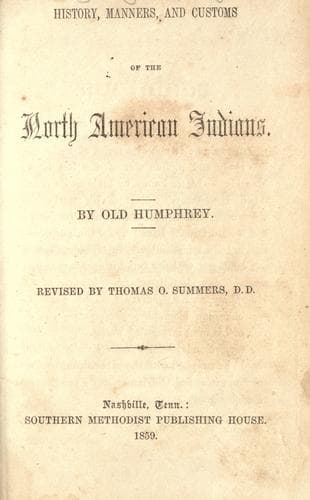
History, Manners, and Customs of the North American Indians — John Shaqi
History, Manners, and Customs of the North American IndiansOld Humphrey
History
History, Manners, and Customs of the North American Indians
Old Humphrey
Indians of North America
"'Braves and warriors! these are the medicine bags of our forefather,
Muk-a-ta-quet, who was the father of the Sac nation. They were handed
down to the great war chief of our nation, Na-na-ma-kee, who has been
at war with all the nations of the lakes, and all the nations of the
plains, and they have never yet been disgraced. I expect you all to
protect them.'
"We went to Mos-co-ho-co-y-nak, where the whites had built a fort. We
had several battles; but the whites so much outnumbered us, it was in
vain. We had not enough to eat. We dug roots, and pulled the bark from
trees, to keep us alive; some of our old people died of hunger. I
determined to remove our women across the Mississippi, that they might
return again to the Sac nation.
"We arrived at the Ouisconsin, and had begun crossing over, when the
enemy came in great force. We had either to fight, or to sacrifice our
women and children. I was mounted on a fine horse, and addressed my
warriors, encouraging them to be brave. With fifty of them I fought
long enough to let our women cross the river, losing only six men:
this was conduct worthy a brave.
"It was sad for us that a party of soldiers from Prairie du Chien were
stationed on the Ouisconsin, and these fired on our distressed women:
was this brave? No. Some were killed, some taken prisoners, and the
rest escaped into the woods. After many battles, I found the white men
too strong for us; and thinking there would be no peace while Black
Hawk was at the head of his braves, I gave myself up and my great
medicine bag. 'Take it,' said I. 'It is the soul of the Sac nation:
it has never been dishonoured in any battle. Take it; it is my life,
dearer than life; let it be given to the great American chief.'
"I understood afterwards, a large party of Sioux attacked our women,
children, and people, who had crossed the Mississippi, and killed
sixty of them: this was hard, and ought not to have been allowed by
the whites.
"I was sent to Jefferson Barracks, and afterwards to my great American
father at Washington. He wanted to know why I went to war with his
people. I said but little, for I thought he ought to have known why
before, and perhaps he did; perhaps he knew that I was deceived and
forced into war. His wigwam is built very strong. I think him to be a
good little man, and a great brave.
"I was treated well at all the places I passed through; Louisville,
Cincinnati, and Wheeling; and afterwards at Fortress Monroe,
Baltimore, Philadelphia, and the big village of New York; and I was
allowed to return home again to my people, of whom Kee-o-kuk, the
Running Fox, is now the chief. I sent for my great medicine bag, for I
wished to hand it down unsullied to my nation.
Public-domain text, read in full here on John Shaqi.
Reviews
Reviews
No reviews yet
Be the first to share your thoughts on this work.
Join the Discussion
Join the discussion
Sign in to leave a comment or review.
Sign InorCreate an account