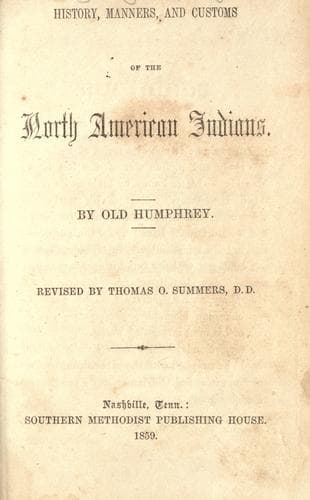
History, Manners, and Customs of the North American IndiansOld Humphrey
History
History, Manners, and Customs of the North American Indians
Old Humphrey
Indians of North America
_Basil._ But the young cattle helped her, for they pushed the bear
with their horns.
_Brian._ Please to tell us about wild horses.
_Hunter._ The hordes or bands of wild horses that abound in some of
the prairies, are supposed to be the offspring of Spanish horses,
brought to Mexico by Europeans. They are extremely shy, keen in their
sight and swift of foot, so that to come up with them, except by
surprise, is no easy thing. I have seen them in great numbers from
the brow of a bluff, or have peeped at them cautiously from a ravine.
_Austin._ What kind of horses are they; and of what colour?
_Hunter._ Some of them are fine animals, but in general they are
otherwise. Stunted and coarse in appearance, they are of various
colours--bay, chestnut, cream, gray, piebald, white and black, with
long tails, fetlocks, top-knots and manes.
_Brian._ How do they catch them?
_Hunter._ In different ways. Sometimes a well-mounted Indian, armed
with his rifle, follows a horde of horses, until he can get a fair
shot at the best among them. He aims at the top of the neck, and if he
succeeds in striking the high gristle there, it stuns the animal for
the moment, when he falls to the ground without being injured. This is
called _creasing_ a horse: but a bad marksman would kill, and not
crease, the noble animal he seeks to subdue.
_Austin._ What other way is there of catching wild horses? for that
seems to be a very bad one.
_Basil._ It is a very bad way. They ought not to shoot them.
_Hunter._ They are much more commonly taken with the _lasso_; which is
a thong at least a dozen yards long, ending in a noose. This the
Indians throw, at full gallop, over the head of the flying steed they
wish to secure. Rarely do they miss their aim. When a horse is thus
caught, the hunter leaps from his steed, and lets out the lasso
gradually, choking his captive till he is obliged to stop: he then
contrives to hopple or tie his fore-legs; to fasten the lasso round
his lower jaw; to breathe in his nostrils, and to lead him home.
_Austin._ Breathe in his nostrils! Why, what does he do that for?
_Hunter._ Because experience has taught him, that it does much towards
rendering his captive more manageable. It is said, that if an Indian
breathes freely into the nostrils of a wild young buffalo on the
prairie, the creature will follow him with all the gentleness and
docility of a lamb.
_Brian._ Well! that does appear strange!
_Hunter._ There is one animal, which the Indians, the hunters and
trappers sometimes meet with, that I have not mentioned. It is the
cougar, or panther, or American lion; for it goes by all these names.
Now and then it is to be seen in the thick forests of the west; but,
being a sad coward, it is not so much dreaded as it otherwise would
be.
_Brian._ I should not much like to meet a cougar.
Public-domain text, read in full here on John Shaqi.
Reviews
Reviews
No reviews yet
Be the first to share your thoughts on this work.
Elsewhere in the archive
Join the Discussion
Join the discussion
Sign in to leave a comment or review.
Sign InorCreate an account