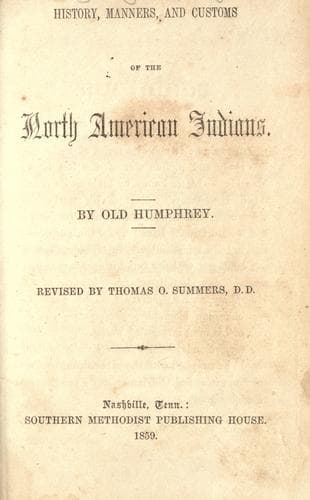
History, Manners, and Customs of the North American IndiansOld Humphrey
History
History, Manners, and Customs of the North American Indians
Old Humphrey
Indians of North America
_Hunter._ The common wolf of America is as big as a Newfoundland dog,
and a sulky, savage-looking animal he is. So long as he can feed in
solitary places he prefers to do so, but, when hunger-pressed, he
attacks the fold; after which, Mr. Grizzly-skin loses no time in
getting to a place of shelter, for he knows that should he outrun the
stanch hounds that will soon be on his track, yet will a rifle ball
outrun him.
_Brian._ Yes, yes; Mr. Grizzly-back is very cunning.
_Hunter._ The prairie-wolf is smaller than the common wolf.
Prairie-wolves hunt after deer which they generally overtake; or keep
close to a buffalo herd, feeding on such as die, or on those that are
badly wounded in fighting with one another. The white, black, and
clouded wolves are in the northern parts. There are many kinds of
deer. I told you, that sometimes a deer-hunt took place on a large
scale, by enclosing a circle, and driving the deer into it. In
shooting antelopes, the hunter has only to stick up his ramrod in the
ground in their neighbourhood, and throw over it his handkerchief;
while he, with his rifle ready loaded, lies on the grass near at hand.
The antelopes will soon approach the handkerchief to see what it is,
when the hunter may make them an easy prey. The largest deer is the
moose deer, which is often seven feet high. He is an awkward,
overgrown-looking creature, with broad horns; but, awkward as he is, I
question if any of you could outrun him. Mountain and valley, lake and
river, seem alike to him, for he crosses them all. In the snow, to be
sure, the unwearied and persevering hound will overtake him; but let
him beware of his horns, or he will be flying head over heels in the
air in a twinkling. The moose deer, however, cannot successfully
strive with the hunter's rifle.
_Austin._ Nothing can stand against man.
_Hunter._ And yet what is man opposed to his Maker? His strength is
perfect weakness! In a moment, in a twinkling of an eye, he "changes
his countenance, and sends him away."
_Basil._ What other kinds of deer do Indians catch?
[Illustration: The Wapiti Deer.]
_Hunter._ The elk, with his large branching horns, who would despise a
palace as a dwelling-place. Nothing less than the broad sky above his
head, and the ground of the boundless forest beneath his feet, will
satisfy him. After the elk, come the Virginia, or common deer, the
wapiti deer, the black-tailed deer, and the cariboo. All these are the
prey of the hunter. Their savoury flesh supplies him with food, and
their soft skins are articles of merchandise. The mountain sheep may
often be seen skipping from one ledge to another of the rugged rocks,
and precipitous clayey cliffs of the western wilds, giving life to
the solitary place, and interest to the picturesque beauty of lonely
spots.
_Austin._ You have mentioned all the animals now, I think, that the
hunter chases; for you spoke before about beavers, badgers, foxes,
raccoons, squirrels and some others.
Public-domain text, read in full here on John Shaqi.
Reviews
Reviews
No reviews yet
Be the first to share your thoughts on this work.
Elsewhere in the archive
Join the Discussion
Join the discussion
Sign in to leave a comment or review.
Sign InorCreate an account