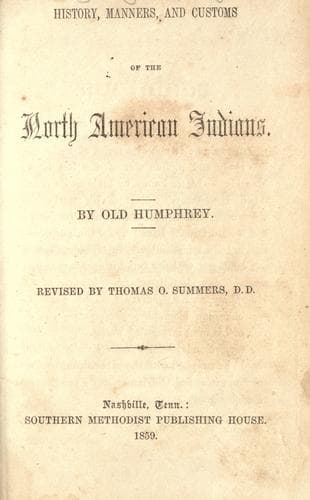
History, Manners, and Customs of the North American IndiansOld Humphrey
History
History, Manners, and Customs of the North American Indians
Old Humphrey
Indians of North America
_Basil._ You have never told us, though, how they catch the musk-rat.
I should like to know that.
_Hunter._ Well, then, I will tell you how they take the musk-rat, but
must first speak about the prairie dog. Prairie dogs are a sort of
marmot, but their bark is somewhat like that of a small dog. Rising
from the level prairie, you may sometimes see, for miles together,
small hillocks of a conical form, thrown up by the prairie dogs, which
burrow some eight or ten feet in the ground. On a fine day, myriads of
these dogs, not much unlike so many rats, run about, or sit barking on
the tops of their hillocks. The moment any one approaches them, they
disappear, taking shelter in their burrows.
_Basil._ Oh, the cunning little rogues.
_Hunter._ The musk-rat builds his burrow (which looks like a
hay-stack) of wild rice stalks; so that, while he has a dry lodging, a
hole at the bottom enables him, when he pleases, to pass into the
shallow water beneath his burrow or lodge. In taking a musk-rat, a
person strikes the top of the burrow, and out scampers the tenant
within; but no sooner does he run through his hole into the shallow
water, than he is instantly caught with a spear. Myriads of these
little animals are taken in this manner for their fur.
_Brian._ They must be a good deal like prairie dogs, though one has
his house on the land, and the other in the water.
_Hunter._ These wide prairies, on which roam bisons and horses and
deer innumerable; and these shallow waters, where musk-rats abound,
will probably, in succeeding years, assume another character. White
men will possess them; civilized manners and customs will prevail, and
Christianity spread from the Mississippi to the Rocky Mountains; for
the kingdoms of the world, you know, are to become the kingdoms of our
Lord and of his Christ.
_Austin._ You have told us a great deal indeed, to-day, about the
prairies.
_Hunter._ I have already spoken of the prairie fires; I mean the
burning grass set on fire by accident, or purposely, for the double
advantage of obtaining a clearer path and an abundant crop of fresh
grass; but I must relate an adventure of my own, of a kind not likely
to be forgotten. So long as a prairie fire is confined to the high
grounds, there is very little danger from it; for, in such situations,
the grass being short, the fire never becomes large, though the line
of flame is a long one. Birds and beasts retire before it in a very
leisurely manner; but in plains where the grass is long, it is very
different.
_Austin._ I should like to see one of those great, high, round bluffs
on fire. There must be a fine bonfire then.
_Hunter._ There you are mistaken, for as I have already told you, the
grass is short on the bluffs. To be sure, the sight of a bluff on
fire, on a dark night, is very singular; for as you can only see the
curved line of flame, the bluff being hidden by the darkness, so it
seems as though the curved lines of flame were up in the air, or in
the sky.
Public-domain text, read in full here on John Shaqi.
Reviews
Reviews
No reviews yet
Be the first to share your thoughts on this work.
Elsewhere in the archive
Join the Discussion
Join the discussion
Sign in to leave a comment or review.
Sign InorCreate an account