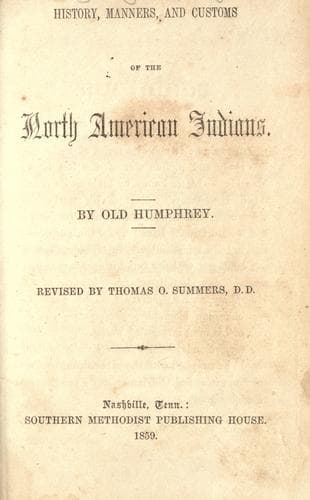
History, Manners, and Customs of the North American IndiansOld Humphrey
History
History, Manners, and Customs of the North American Indians
Old Humphrey
Indians of North America
_Hunter._ The green corn dance of the Minatarees must be described to
you. Among Indian tribes, green corn is a great luxury, and the time
when it ripens is a time of rejoicing. Dances and songs of
thanksgiving are abundant; and the people give way not only to
feasting, but also to gluttony; so that often, by abusing the
abundance in their possession, they bring upon themselves the miseries
of want. The Indians have very little fore-thought. To enjoy the
present, and to trust the future to the Great Spirit, is their
constant practice.
_Austin._ How long does the green corn dance last?
_Hunter._ For eight or ten days, during which time there is the most
unbounded prodigality. Among many of the tribes, the black drink, a
very powerful medicine, is taken two or three days before the feast,
that the green corn may be eaten with a sharp appetite and an empty
stomach.
_Brian._ In what way does the green corn dance begin?
_Hunter._ As soon as the corn is in a proper state--and this is
decided by the mystery men--runners are despatched through the
village, that all may assemble on the following day to the dance and
the feast. Sufficient corn for the required purpose is gathered by the
women, who have the fields under their care, and a fire is made, over
which a kettle, with green corn in it, is kept boiling; while medicine
men, whose bodies are strangely painted, or bedaubed with clay of a
white colour, dance round it in very uncouth attitudes, with
corn-stalks in their hands.
_Austin._ I dare say, while the pot is boiling, they are all longing
to begin the feast.
_Hunter._ The first kettle-full is not for themselves, it is an
offering to the Great Spirit. There are many customs among the Indians
which cannot but bring the Jews to our remembrance; and this offering
of the first green corn does so very forcibly. The medicine men round
the fire shake their rattles, hold up their corn-stalks, and sing
loudly a song of thanksgiving, till the corn is sufficiently boiled;
it is then put upon the fire and consumed to a cinder. Before this
offering is made, none of the Indians would dare to taste of the
luxurious fare; but, afterwards, their appetite is unrestrained.
_Austin._ Then they begin to boil more corn, I suppose.
_Hunter._ A fresh fire is made, a fresh kettle of corn is prepared,
and the dance goes on; the medicine men keeping close to the fire, and
the others capering and shouting in a larger circle, their energy
increasing as the feast approaches nearer and nearer. The chiefs and
medicine men then sit down to the feast, followed by the whole tribe,
keeping up their festivity day after day, till the corn-field has
little more grain remaining in it than what is necessary for seed. You
have heard the saying, "Wilful waste brings woful want." The truth of
this saying is often set forth, as well in civilized life as among the
Indians.
_Basil._ I wonder what dance will come next.
Public-domain text, read in full here on John Shaqi.
Reviews
Reviews
No reviews yet
Be the first to share your thoughts on this work.
Elsewhere in the archive
Join the Discussion
Join the discussion
Sign in to leave a comment or review.
Sign InorCreate an account