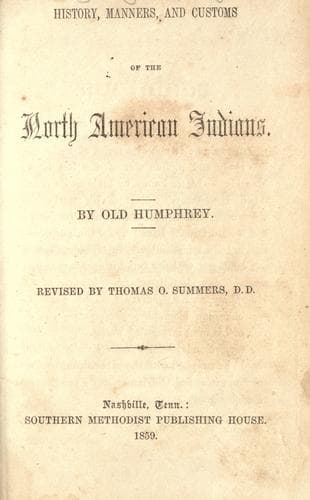
History, Manners, and Customs of the North American IndiansOld Humphrey
History
History, Manners, and Customs of the North American Indians
Old Humphrey
Indians of North America
_Hunter._ I need not describe many others. If I run rapidly through
two or three, and dwell a little on the bear dance and the war dance,
you will then have heard quite enough about dances. The scalp dance is
in use among the Sioux or Dahcotas. It is rather a fearful exhibition;
for women, in the centre of a circle, hold up and wave about the
scalps which have been torn from the slaughtered foes of the tribe,
while the warriors draw around them in the most furious attitudes,
brandishing their war-clubs, uttering the most hideous howls and
screams. The Indians have many good qualities, but cruelty seems to
mingle with their very nature. Every thing is done among them that can
be done, to keep alive the desire to shed blood. The noblest act a red
man can perform, and that which he thinks the most useful to his tribe
and the most acceptable to the Great Spirit, is to destroy an enemy,
and to bear away his scalp as a trophy of his valour. If it were only
for this one trait in the Indian character, even this would be
sufficient to convince every humane person, and especially every
Christian, of the duty and great advantage of spreading among them the
merciful principles of Christianity. A holy influence is necessary to
teach the untutored red man to forgive his enemies, to subdue his
anger, to abate his pride, and to stay his hand in shedding human
blood. The new commandment must be put in his heart: "That ye love one
another." The Mandan boys used to join in a sham scalp dance, in which
they conducted themselves just like warriors returning from a
victorious enterprise against their enemies.
_Basil._ They are all sadly fond of fighting.
_Hunter._ In the brave dance, of the Ojibbeways, there is plenty of
swaggering: the dancers seem as if they knew not how to be proud
enough of their warlike exploits. The eagle dance, among the Choctaws,
is an elegant amusement; and the snow-shoe dance, of the Ojibbeways,
is a very amusing one.
_Brian._ Please to tell us about them both.
_Hunter._ I must not stay to describe them particularly: it will be
enough to say, that, in the one, the dancers are painted white, and
that they move about waving in their hands the tail of the eagle; in
the other--which is performed on the first fall of snow, in honour of
the Great Spirit--the dancers wear snow-shoes, which, projecting far
before and behind their feet, give them in the dance a most strange
and laughable appearance.
_Brian._ I should very much like to see that dance; there is nothing
cruel in it at all.
_Basil._ And I should like to see the eagle dance, for there is no
cruelty in that either.
_Hunter._ The straw dance is a Sioux dance of a very curious
description. Loose straws are tied to the bodies of naked children;
these straws are then set on fire, and the children are required to
dance, without uttering any expression of pain. This practice is
intended to make them hardy, that they may become the better warriors.
Public-domain text, read in full here on John Shaqi.
Reviews
Reviews
No reviews yet
Be the first to share your thoughts on this work.
Elsewhere in the archive
Join the Discussion
Join the discussion
Sign in to leave a comment or review.
Sign InorCreate an account