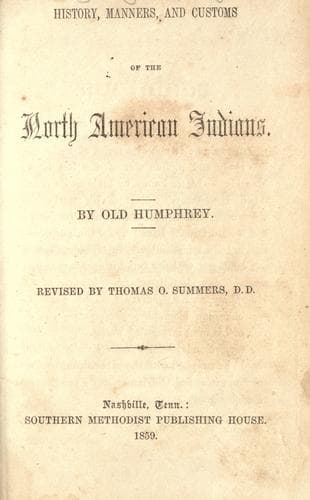
History, Manners, and Customs of the North American IndiansOld Humphrey
History
History, Manners, and Customs of the North American Indians
Old Humphrey
Indians of North America
_Basil._ That is one of the strangest dances of all.
_Hunter._ I will now say a little about the bear dance, and the war
dance. The bear dance is performed by the Sioux before they set off on
a bear-hunt. If the bear dance were left unperformed, they would
hardly hope for success. The Bear spirit, if this honour were not paid
to him, would be offended, and would give them no success in the
chase.
_Austin._ What! do the Sioux think there is a Bear spirit?
[Illustration: Bear Dance.]
_Hunter._ Yes. The number of spirits of one kind or another, believed
in by the Indians, is very great. In the bear dance, the principal
performer has a bear-skin over him, the head of it hanging over his
head, and the paws over his hands. Others have masks of bears' faces;
and all of them, throughout the dance, imitate the actions of a bear.
They stoop down, they dangle their hands, and make frightful noises,
beside singing to the Bear spirit. If you can imagine twenty bears
dancing to the music of the rattle, whistle, and drum, making odd
gambols, and yelling out the most frightful noises, you will have some
notion of the bear dance.
_Brian._ Now for the war dance: that is come at last.
_Hunter._ It is hardly possible to conceive a more exciting spectacle
than that of the war dance among the Sioux. It exhibits Indian manners
on the approach of war. As, among civilized people, soldiers are
raised either by recruiting or other means; so, among the Indians,
something like recruiting prevails. The red pipe is sent through the
tribe, and every one who draws a whiff up the stem thereby declares he
is willing to join the war party. The warriors then assemble together,
painted with vermilion and other colours, and dressed in their war
clothes, with their weapons and their war-eagle head-dresses.
_Austin._ What a sight that must be!
_Hunter._ When the mystery man has stuck up a red post in the ground,
and begun to beat his drum, the warriors advance, one after another,
brandishing their war-clubs, and striking the red post a violent blow,
while the mystery man sings their death-song. When the warriors have
struck the post, they blacken their faces, and all set to dancing
around it. The shrill war-whoop is screamed aloud, and frantic
gestures and frightful yells show, but too plainly, that there will be
very little mercy extended to the enemy that falls into their hands.
_Brian._ That war dance would make me tremble.
_Hunter._ The Mandan boys used to assemble at the back of their
village, every morning, as soon as the sun was in the skies, to
practise sham fighting. Under the guidance and direction of their
ablest and most courageous braves and warriors, they were instructed
in all the mysteries of war. The preparations, the ambush, the
surprise, the combat and the retreat, were made familiar to them. Thus
were they bred up from their youth to delight in warfare, and to long
for opportunities of using their tomahawks and scalping-knives against
their foes.
Public-domain text, read in full here on John Shaqi.
Reviews
Reviews
No reviews yet
Be the first to share your thoughts on this work.
Elsewhere in the archive
Join the Discussion
Join the discussion
Sign in to leave a comment or review.
Sign InorCreate an account