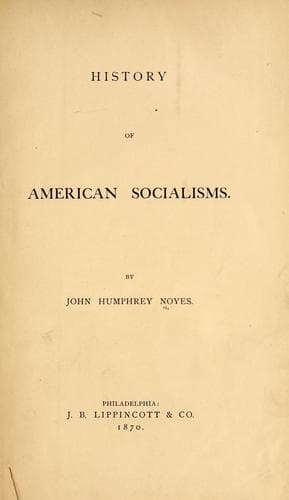
History of American SocialismsNoyes, John Humphrey
History
History of American Socialisms
Noyes, John Humphrey
Communism -- United States; Socialism -- United States
But to do complete justice we must go a step further. While we say
that the Rappites, the Zoarites, the Ebenezers, the Owenites, and even
the Fourierites are all echoes of the Shakers, we must also
acknowledge that the Shakers are the far-off echoes of the PRIMITIVE
CHRISTIAN CHURCH.
CHAPTER XVII.
FUNDAMENTALS OF SOCIALISM.
The main idea on which Owen and Fourier worked was the same. Both
proposed to reconstruct society by gathering large numbers into
unitary dwellings. Owen had as clear sense of the compound economies
of Association as Fourier had, and discoursed as eloquently, if not as
scientifically, on the beauties and blessings of combined industry.
Both elaborated plans for vast buildings, which they proposed to
substitute for ordinary family dwellings. Owen's communal edifice was
to be a great hollow square, somewhat like a city block. Fourier's
phalanstery, on the other hand, was to be a central palace with two
wings. In like manner their plans of reconstructing society differed
in details, but the main idea of combination in large households was
the same.
What they undertook to do may be illustrated by the history of
bee-keeping. The usual way in this business is to provide hives that
will hold only a few quarts of bees each, and so compel new
generations to swarm and find new homes. But it has always been a
problem among ingenious apiarians, how to construct compound hives,
that will prevent the necessity of swarming, and either allow a single
swarm to increase indefinitely, or induce many swarms to live
together in contiguous apartments. We remember there was an invention
of this kind that had quite a run about the time of the Fourier
excitement. It was not very successful; and yet the idea seems not
altogether chimerical; for it is known that wild bees, in certain
situations, as in large hollow trees and in cavities among rocks, do
actually accumulate their numbers and honey from generation to
generation. Owen and Fourier, like the apiarian inventors (who are
proverbially unpractical), undertook to construct, each in his own
way, great compound hives for human beings; and they had the example
of the Shakers (who may be considered the wild bees in the
illustration) to countenance their schemes.
The difference of their methods was this: Owen's plan was based on
_Communism_; Fourier's plan was based on the _Joint-stock_ principle.
Both of these modes of combination exist abundantly in common society.
Every family is a little example of Communism; and every working
partnership is an example of Joint-stockism. Communism creates homes;
Joint-stockism manages business. Perhaps national idiosyncracies had
something to do with the choice of principles in these two cases.
_Home_ is an English word for an English idea. It is said there is no
equivalent word in the French language. Owen, the Englishman, chose
the home principle. Fourier, the Frenchman, chose the business
principle.
Public-domain text, read in full here on John Shaqi.
Reviews
Reviews
No reviews yet
Be the first to share your thoughts on this work.
Elsewhere in the archive
Join the Discussion
Join the discussion
Sign in to leave a comment or review.
Sign InorCreate an account