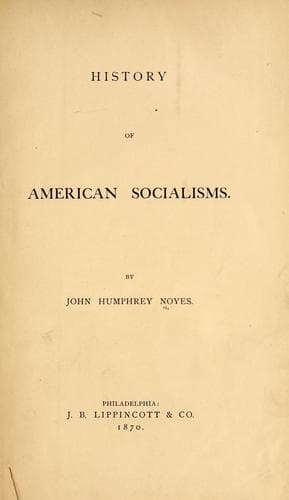
History of American SocialismsNoyes, John Humphrey
History
History of American Socialisms
Noyes, John Humphrey
Communism -- United States; Socialism -- United States
These two principles, as they exist in the world, are not
antagonistic, but reciprocal. Home is the center from which men go
forth to business; and business is the field from which they go home
with the spoil. Home is the charm and stimulus of business; and
business provides material for the comfort and beauty of home. This
is the present practical relation between Communism and Joint-stockism
every-where. And these two principles, thus working together, have had
a wonderful expansion in modern times. Every body knows what progress
has been made in Joint-stockism, from the old-fashioned simple
partnership, to the thousands of corporations, small and great, that
now do the work of the world. But Communism has had similar progress,
from the little family circle, to the thousands of benevolent
institutions that are now striving to make a home of the world. Every
hospital and free school and public library that is comforting and
civilizing mankind, is an extension of the free, loving element, that
is the charm of home. And it is becoming more and more the fashion for
men to spend the best part of their lives in accumulating millions by
Joint-stockism, and at last lay their treasures at the feet of
Communism, by endowing great public institutions of mercy or
education.
As these two principles are thus expanding side by side, the question
arises, Which on the whole is prevailing and destined to prevail? and
that means, which is primary in the order of truth, and which is
secondary? The two great socialistic inventors seem to have taken
opposite sides on this question. Owen believed that the grand advance
which the world is about to make, will be into Communism. Fourier as
confidently believed that civilization will ripen into universal
Joint-stockism. In all cases of reciprocal dualism, there is
manifestly a tendency to mutual absorption, coalescence and unity.
Where shall we end? in Owenism or Fourierism? Or will a combination of
both keep its place in the world hereafter, as it has done hitherto?
and if so which will be primary and which secondary, and how will
they be harmonized? We do not propose to answer these questions, but
only to help the study of them, as we proceed with our history.
Public-domain text, read in full here on John Shaqi.
Reviews
Reviews
No reviews yet
Be the first to share your thoughts on this work.
Elsewhere in the archive
Join the Discussion
Join the discussion
Sign in to leave a comment or review.
Sign InorCreate an account