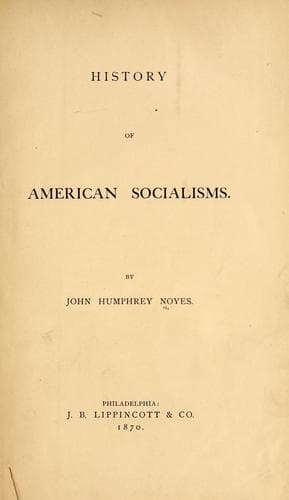
History of American SocialismsNoyes, John Humphrey
History
History of American Socialisms
Noyes, John Humphrey
Communism -- United States; Socialism -- United States
On the whole it seems to us that it should be considered settled by
reason and experience, that the rule we have found governing the
prudential theory of marriage on the small scale, should be
transferred to the theory of Association, which is really marriage on
the large scale. Better not marry at all, than marry a religious
quarrel. Better have no religion, than have a dozen different
religions, as they had at Clarkson. If you mean to found a Community
for peace and permanence, first of all find associates that agree with
you in religion, or at least in no-religion, and if possible bar out
all others. Remember that all the successful Communities are
harmonious, and the basis of their harmony is unity in religion. If
you think you can find a way to secure harmony in no-religion, try it.
But don't be so foolish as to enter on the tremendous responsibilities
of Community-building, with a complication of religious quarrels
lurking in your material.
CHAPTER XXV.
OTHER NEW YORK EXPERIMENTS.
The next on the list of the Confederated Associations of western New
York, was
THE BLOOMFIELD ASSOCIATION.
We have but meager accounts of this experiment. Macdonald does not
mention it. The _Phalanx_ of June 15, 1844, says that it commenced
operations on the 15th of March in that year, on a domain of about
five hundred acres, mostly improved land, situated one mile east of
Honeoye Falls, in the Counties of Monroe, Livingston and Ontario; that
it was in debt for its land about $11,000, and had $35,000 of its
subscriptions actually paid in; that it had one hundred and
forty-eight resident members, and a large number more expecting to
join, as soon as employment could be found for them. Two or three
allusions to this Association occur afterward in the _Phalanx_,
congratulating it on its prospects, and mentioning good reports of its
progress. Finally in the _Harbinger_, volume 1, page 247, we find a
letter from E.D. Wight and E.A. Stillman, dated August 20, 1845,
defending the Association against newspaper charges, and asserting its
continued prosperity; but giving us the following peep into a
complication of troubles, that probably brought it to its end shortly
afterwards:
"We are not fully satisfied with the tenor by which our real
estate, under the existing laws, is obliged to be held.
Conveyances, pursuant to legal advice, were made originally by
the owners of each particular parcel, to the committee of
finance, in trust for the stockholders and members; and a power
was executed by the stockholders to the committee, by which,
under certain regulations, they were to have authority to sell
and convey the same. The absurdity of the Statute of Trusts
never having been licked into shape by judicial decisions, a
close and unavailing search has since been instituted for the
fugitive legal title.
Public-domain text, read in full here on John Shaqi.
Reviews
Reviews
No reviews yet
Be the first to share your thoughts on this work.
Elsewhere in the archive
Join the Discussion
Join the discussion
Sign in to leave a comment or review.
Sign InorCreate an account