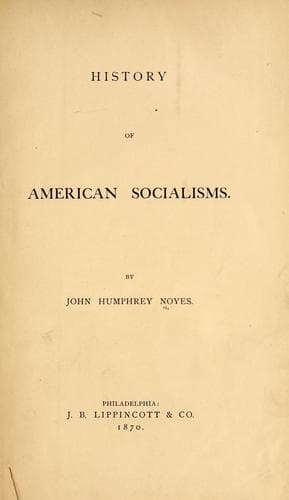
History of American SocialismsNoyes, John Humphrey
History
History of American Socialisms
Noyes, John Humphrey
Communism -- United States; Socialism -- United States
Mrs. Esther Ann Lukens, a member of the Marlboro Community, answered
Macdonald's inquiries about its history. We copy the greater part of
her story:
_Mrs. Lukens's Narrative._
"The Marlboro Community seems, as I think of it, to have had its
existence so entirely in dreams of human advancement and the
generous wish to promote it, and also in ignorance of all but
the better part of human nature, that it is hard to speak of it
as a _bona fide_ portion of our plodding work-a-day world.
"It was originated by a few generous and ardent spirits, who
were disgusted with the oppressive and antagonistic conditions
of ordinary labor and commerce. The only remedy they saw, was a
return to the apostolic manner of living--that of 'having all
things common.'
"The Association was first talked of and its principles
generally discussed in Clinton County, some years before
anything was done. Many in all parts of Ohio participated in
this discussion, and warmly urged the scheme; but only a few
were found who were hopeful and courageous enough to dare the
final experiment.
"The gathering commenced in 1841 on the farm of Mr. E. Brooke,
and consisted at first of his family and a few other persons.
Gradually the number increased, and another farm was added by
the free gift of Dr. A. Brooke, or rather by his resigning all
right and title to it as an individual, and delivering it over
to the joint ownership of the great family.
"As may be supposed, the majority of those who gathered around
this nucleus, were without property, and very slenderly gifted
with the talent of acquiring it, but thoroughly honest,
philanthropic, warmly social, and willing to perform what
appeared to them the right amount of labor belonging to freemen
in a right state of society. They forgot in a few instances,
that this right state did not exist, but was only dreamed about,
and had yet to be realized by more than common labor with the
hands.
"The Community had but little property of any value but land,
and that was in an uncultivated, half-wild state. There were a
few hundred dollars in hand; I can not say how many; but
certainly not half the amount required for purchases that seemed
immediately necessary. There was a good house and barn on each
farm, each house capable of accommodating comfortably three
families, besides three small tenant houses of logs, capable of
accommodating one family each. There were also on the premises
four or five horses and a few cattle and sheep.
Public-domain text, read in full here on John Shaqi.
Reviews
Reviews
No reviews yet
Be the first to share your thoughts on this work.
Elsewhere in the archive
Join the Discussion
Join the discussion
Sign in to leave a comment or review.
Sign InorCreate an account