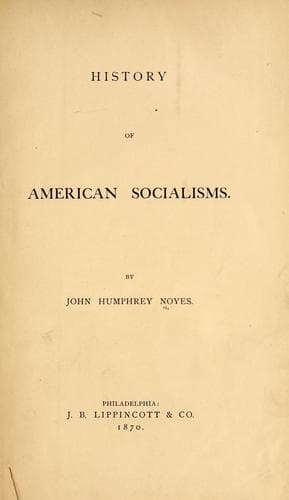
History of American SocialismsNoyes, John Humphrey
History
History of American Socialisms
Noyes, John Humphrey
Communism -- United States; Socialism -- United States
In the first years of the present century, old Wuertemburg, a province
always famous for its religious enthusiasms, was fermenting with
excitement about the Millennium; and many of its enthusiasts were
expecting the speedy personal advent of Christ. Among these George
Rapp became a prominent preacher, and led forth a considerable sect
into doctrines and ways that brought upon him and them severe
persecutions. In 1803 he came to America to find a refuge for his
flock. After due exploration he purchased 5000 acres of land in Butler
Co., Pennsylvania, and commenced a settlement which he called Harmony.
In the summer of 1804 two ship-loads of his disciples with their
families--six hundred in all--came over the ocean and joined him. In
1805 the Society was formally organized as a Christian Community, on
the model of the Pentecostal church. For a time their fare was poor
and their work was hard. An evil eye from their neighbors was upon
them. But they lived down calumny and suspicion by well-doing, and
soon made the wilderness blossom around them like the rose. In 1807
they adopted the principle of celibacy; but in other respects they
were far from being ascetics. Music, painting, sculpture, and other
liberal arts flourished among them. Their museums and gardens were the
wonder and delight of the region around them. In 1814, desiring warmer
land and a better location for business, they sold all in Pennsylvania
and removed to Indiana. On the banks of the Wabash they built a new
village and again called it Harmony. Here they prospered more than
ever, and their number increased to nearly a thousand. In 1824 they
again became discontented with their location, on account of bad
neighbors and malaria. Again they sold all, and returned to
Pennsylvania; but not to their old home. They built their third and
final village in Beaver Co, near Pittsburgh, and called it Economy.
There they are to this day. They own railroads and oil wells and are
reported to be millionaires of the unknown grade. In all their
migrations from the old world to the new, from Pennsylvania to
Indiana, and from Indiana back to Pennsylvania; in all their perils by
persecutions, by false brethren, by pestilence, by poverty and wealth,
their religion held them together, and their union gave them the
strength that conquers prosperity. A notable example of what a hundred
families can do when they have the wisdom of harmony, and fight the
battle of life in a solid phalanx! A nobler "six hundred" than the
famous dragoons of Balaklava!
Such were the people who gave Robert Owen his first lessons in
Communism, and sold him their home in Indiana. Ten of their best years
they spent in building a village on the Wabash, not for themselves (as
it turned out), but for a theater of the great infidel experiment.
Rev. Aaron Williams, D.D., the historian to whom we are indebted for
the facts of the above sketch, thus describes the negotiations and the
transfer:
Public-domain text, read in full here on John Shaqi.
Reviews
Reviews
No reviews yet
Be the first to share your thoughts on this work.
Join the Discussion
Join the discussion
Sign in to leave a comment or review.
Sign InorCreate an account