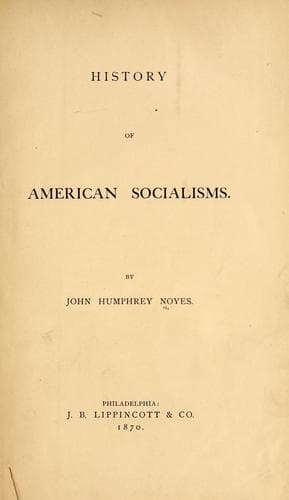
History of American SocialismsNoyes, John Humphrey
History
History of American Socialisms
Noyes, John Humphrey
Communism -- United States; Socialism -- United States
"We learn from a personal interview with Mr. Thornburg, whose
letter on the Ohio Phalanx was alluded to in a recent number of
the _Phalanx_, that the affairs of that Association wear a very
promising aspect, and that there can be no reasonable doubt of
its success. He gives a very favorable description of the soil
and general resources of the domain, and from all that we have
learned of its character, we believe there are few localities at
the West better adapted for the purposes of an experimental
Association on a large scale. We sincerely hope that our friends
in that vicinity will concentrate their efforts on the Ohio
Phalanx, and not attempt to multiply Associations, which,
without abundant capital and devoted and experienced men, will,
almost to a certainty, prove unsuccessful. The true policy for
all friends of Associative movements, is to combine their
resources, and give an example of a well-organized Phalanx, in
complete and harmonic operation. This will do more for the cause
than any announcement of theories, however sound and eloquent,
or ten thousand abortive attempts begun in enthusiasm and
forsaken in despair."
[From the correspondence of the _Harbinger_, July 19, 1845,
announcing the final dissolution.]
"On the 24th of June last, the Ohio Phalanx again dissolved. The
reason is the want of funds. Since the former dissolution they
have obtained no accession of numbers or capital worth
considering. The members, I presume, will now disperse. They all
retain, I believe, their sentiments in favor of Association; but
they have not the means to go on."
Macdonald contributes the following summary, to close the account:
[From the Journal of a Resident Member of the Ohio Phalanx.]
"At the commencement of the experiment there was general
good-humor among the members. There seemed to be plenty of
means, and there was much profusion and waste. There was no
visible organization according to Fourier, most of the members
being inexperienced in Association. They were too much crowded
together, had no school nor reading-room, and the younger
members, as might be expected, were at first somewhat unruly.
The character of the Association had more of a sedate and
religious tone, than a lively or social one. There was too much
discussion about Christian union, etc., and too little practical
industry and business talent. No weekly or monthly accounts were
rendered.
Public-domain text, read in full here on John Shaqi.
Reviews
Reviews
No reviews yet
Be the first to share your thoughts on this work.
Elsewhere in the archive
Join the Discussion
Join the discussion
Sign in to leave a comment or review.
Sign InorCreate an account