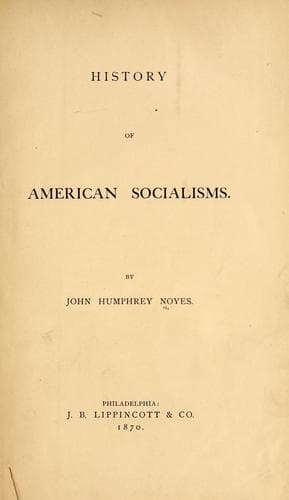
History of American SocialismsNoyes, John Humphrey
History
History of American Socialisms
Noyes, John Humphrey
Communism -- United States; Socialism -- United States
"Sept. 17. A large meeting of all the Societies and the whole
population of the town took place at the Hall, for the purpose of
considering a plan for the '_amelioration of the Society_, to improve
the condition of the people, and make them more contented.' A message
was received from Mr. Owen proposing to form a Community with as many
as would join him, and put in all their property, save what might be
thought necessary to reserve to help their friends; the government to
consist of Robert Owen and four others of his choice, to be appointed
by him every year; and not to be altered for five years. This movement
of course nullified all previous organizations. Disagreements and
jealousies ensued, and, as was the case on a former change being made,
many persons left New Harmony.
"Nov. 1. The _Gazette_ says: 'Eighteen months experience has proved to
us, that the requisite qualifications for a permanent member of the
Community of Common Property are, 1, Honesty of purpose; 2,
Temperance; 3, Industry; 4, Carefulness; 5, Cleanliness; 6, Desire for
knowledge; 7, A conviction of the fact that the character of man is
formed for, and not by, himself.'
"Nov. 8. Many persons leaving. The _Gazette_ shows how impossible it
is for a Community of common property to exist, unless the members
comprising it have acquired the genuine Community character.
"Nov. 11. Mr. Owen reviewed the last six months' progress of the
Community in a favorable light.
"In December the use of ardent spirits was abolished.
"Jan. 1827. Although there was an appearance of increased order and
happiness, yet matters were drawing to a close. Owen was selling
property to individuals; the greater part of the town was now resolved
into individual lots; a grocery was established opposite the tavern;
painted sign-boards began to be stuck up on the buildings, pointing out
places of manufacture and trade; a sort of wax-figure-and-puppet-show
was opened at one end of the boarding-house; and every thing was getting
into the old style."
It is useless to follow this wreck further. Everybody sees it must go
down, and _why_ it must go down. It is like a great ship, wallowing
helpless in the trough of a tempestuous sea, with nine hundred
_passengers_, and no captain or organized crew! We skip to Macdonald's
picture of the end.
"June 18, 1827. The _Gazette_ advertised that Mr. Owen would meet the
inhabitants of New Harmony and the neighborhood on the following
Sunday, to bid them farewell. I find no account of this meeting, nor
indeed of any further movements of Mr. Owen in the _Gazette_. After
his departure the majority of the population also removed and
scattered about the country. Those who remained returned to
individualism, and settled as farmers and mechanics in the ordinary
way. One portion of the estate was owned by Mr. Owen, and the other
by Mr. Maclure. They sold, rented, or gave away the houses and lands,
and their heirs and assigns have continued to do so to the present
day."
Public-domain text, read in full here on John Shaqi.
Reviews
Reviews
No reviews yet
Be the first to share your thoughts on this work.
Join the Discussion
Join the discussion
Sign in to leave a comment or review.
Sign InorCreate an account