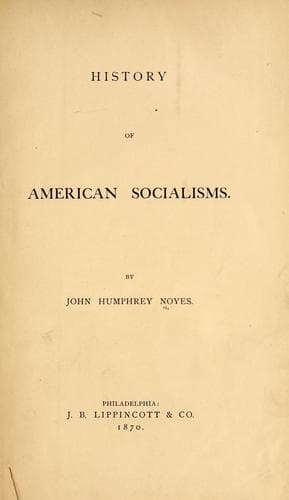
History of American SocialismsNoyes, John Humphrey
History
History of American Socialisms
Noyes, John Humphrey
Communism -- United States; Socialism -- United States
_C.W. Underwood._--"Owen's experiment helped to demonstrate that there
is no such thing as organization or unity without Christ and religion.
But on the other hand we can see that Owen did much good. The churches
were compelled to adopt many of his ideas. He certainly was the father
of the infant-school system; and it is my impression that he started
the reform-schools, houses of refuge, etc. He gave impulse, at any
rate, to the present reformatory movements."
* * * * *
It is noticeable, as a coincidence with our observations on the lust
for land in a preceding chapter, that Owen succeeded admirably in a
factory, and failed miserably on a farm. Whether his 30,000 acres had
anything to do with his actual failure or not, they would probably
have been the ruin of his Community, if it had not failed from other
causes.
We have reason to believe from many hints, that _whisky_ had
considerable agency in the demoralization and destruction of New
Harmony. The affair of Taylor's distillery is one significant fact.
Here is another from Macdonald:
"I was one day at the tan-yard, where Squire B. and some others were
standing, talking around the stove. During the conversation Squire B.
asked us if he had ever told us how he had served 'old Owen' in
Community times. He then informed us that he came from Illinois to New
Harmony, and that a man in Illinois was owing him, and asked him to
take a barrel of whisky for the debt. He could not well get the money;
so took the whisky. When it came to New Harmony he did not know where
to put it, but finally hid it in his cellar. Not long after Mr. Owen
found that the people still got whisky from some quarter, he could not
tell where, though he did his best to find out. At last he suspected
Squire B., and came right into his shop and accused him of it; on
which Squire B. had to own that it was he who retailed the whisky. 'It
was taken for a debt,' said he, 'and what else was I to do to get rid
of it?' Mr. Owen turned round, and in his simple manner said, 'Ah, I
see you do not understand the principles.' This story was finished
with a hearty laugh at 'old Owen.' I could not laugh, but felt that
such men as Squire B. really did not understand the principles; and no
wonder there are failures, when such men as he thrust themselves in,
and frustrate benevolent designs."
It was too early for a Community, when this country was a "nation of
drunkards," as it was in 1825.
Owen's method of getting together the material of his Community, seems
to us the most obvious _external_ cause of his failure. It was like
advertising for a wife; and we never heard of any body's getting a
good wife by advertising. A public invitation to "the industrious and
well-disposed of all nations," to come on and take possession of
30,000 acres of land and a ready-made village, leaving each one to
judge as to his own industry and disposition, would insure a prompt
gathering--and also a speedy scattering.
Public-domain text, read in full here on John Shaqi.
Reviews
Reviews
No reviews yet
Be the first to share your thoughts on this work.
Join the Discussion
Join the discussion
Sign in to leave a comment or review.
Sign InorCreate an account