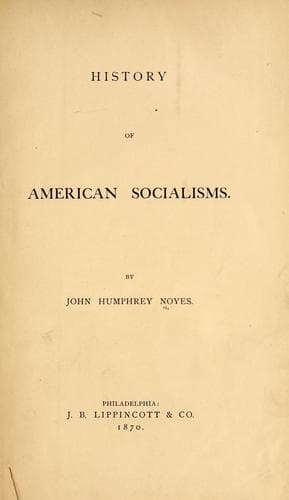
History of American SocialismsNoyes, John Humphrey
History
History of American Socialisms
Noyes, John Humphrey
Communism -- United States; Socialism -- United States
"About the year 1824 Owen arrived in Cincinnati. He brought with him a
history of his labors at New Lanark; with glowing and not unjust
accounts of the beneficent effects of his efforts there. He exhibited
plans for his proposed Communities here; with model farms, gardens,
vineyards, play-grounds, orchards, and all the internal and external
appliances of the social paradise. At Cincinnati he soon found many
congenial spirits, among the first of whom was Daniel Roe, minister of
the "New Jerusalem Church," a society of the followers of Swedenborg.
This society was composed of a very superior class of people. They
were intelligent, liberal, generous, cultivated men and women--many
of them wealthy and highly educated. They were apparently the best
possible material to organize and sustain a Community, such as Owen
proposed. Mr. Roe and many of his congregation became fascinated with
Owen and his Communism; and together with others in the city and
elsewhere, soon organized a Community and furnished the means for
purchasing an appropriate site for its location. In the meantime Owen
proceeded to Harmony, and, with others, purchased that place, with all
its buildings, vineyards, and lands, from Rapp, who emigrated to
Pennsylvania and established his people at Economy. It will only be
added of Owen, that after having seen the New Harmonians fairly
established, he returned to Scotland.
"After careful consultation and selection, it was decided by the
Cincinnati Community to purchase a domain at Yellow Springs, about
seventy-five miles north of the city, [now the site of Antioch
College] as the most eligible place for their purpose. It was really
one of the most delightful regions in the whole West, and well worthy
the residence of a people who had resolved to make many sacrifices for
what they honestly believed to be a great social and moral
reformation.
"The Community, as finally organized consisted of seventy-five or one
hundred families; and included professional men, teachers, merchants,
mechanics, farmers, and a few common laborers. Its economy was nearly
as follows:
"The property was held in trust forever, in behalf of the members of
the Community, by the original purchasers, and their chosen
successors, to be designated from time to time by the voice of the
Community. All additional property thereafter to be acquired, by
labor, purchase, or otherwise, was to be added to the common stock,
for the benefit of each and all. Schools were to be established, to
teach all things useful (except religion). Opinion upon all subjects
was free; and the present good of the whole Community was the standard
of morals. The Sabbath was a day of rest and recreation, to be
improved by walks, rides, plays, and pleasing exercises; and by public
lectures. Dancing was instituted as a most valuable means of physical
and social culture; and the ten-pin alley and other sources of
amusement were open to all.
Public-domain text, read in full here on John Shaqi.
Reviews
Reviews
No reviews yet
Be the first to share your thoughts on this work.
Join the Discussion
Join the discussion
Sign in to leave a comment or review.
Sign InorCreate an account